Pages

Showing posts with label Art. Show all posts

Monday, February 18, 2019

Last Thursday I went to the Musee d'Orsay for the evening opening hours--6-9 pm. This is a good way to avoid the hordes that crowd it during the day. It was a pleasant day, so I elected to walk there (and back) and thoroughly enjoyed that. The tourists are coming back, sigh, but still a walk down the quai is not a madhouse. Nor was the museum, thankfully. I bought a ticket online, but there was absolutely no line when I arrived at 6:15. Popped right in!

My goal was to see to see the Seurats and Sisleys, but on arriving I realized that I had another agenda: the connection between my boy Ed and his gal Berthe Morisot.

I started with The Balcony. This is one of my all-time faves. The best part was that I had it pretty much all to myself. I spent a good 15 minutes just soaking it in, waiting for the occasional tourist to step in front of me and take a picture. Then, I noticed on the adjacent wall a small painting by Manet of Berthe with Violets, very similar to the one I saw at the Marmottan. Smoldering. My word, what a babe. Seriously, they had a thing going on...

These were downstairs. I am forever confused about how they organize the works in these museums. These two paintings (and a few others by Ed) were in a gallery that included Matisse and some Gaugin. Pre-impressionist?

In another gallery on the first floor I saw Olympia. Well, well, guess who? I dunno what the 'experts' say, but I am here to tell ya, that was Berthe. Ooo-la-la. I mean, I don't know about the body, but for sure, those were her eyes. Right next to Olympia was a painting of Zola, with sketches of Olympia in the background, and an art history book in hand. Ed knew what he was doing, yep.

Then I headed upstairs to the Impressionist/Neo-Impressionist/Post-Impressionist gallery. There I found the other painting that I had looked forward to seeing: Dejenuer sur L'Herbe. Oh man, what a painting. I spent another half hour here, again occasionally interrupted by the photo takers, but enjoying all the details that I have seen but haven't, if you know what I mean. The flying bird, the still life (bread, grapes and cheese), the classic nude, the boat, tied up in the middle ground. Comments on art and aesthetics that drove the critics mad excited me yet again, on a whole new level.

Then, I wandered through the rest of the gallery. I have to say, they have some of the best of the best here, including Monet. Here I saw for the first time that it was his early works that I admire so much--the stuff from the 1860's through the '70's. This man had what I would call 'the hand'. Just compared with Sisleys, Pissaro's and (the sole) Morisot, he just had the touch. It makes the others look like they were stabbing at the canvas with their brushes.

Now after about 1880 or so, Monet seems to have lost the touch imho. After this, he had a much 'looser' (read less skilled) touch, leading into the Haystacks, the Amiens series and what I consider to be the worst, the Water Lilies. I know, I know, everyone fawns over these, but I seriously think they show a famous painter in decline.

By the way, a recent article I happened across revealed that he likely felt this way as well. Shortly before a major exhibition in 1908, he took a knife and a sharp pen to several dozen of his works, declaring them unfit. He might have been right--they works are lost to history, though. I suspect he would be horrified to discover what Michel did with all the works he didn't get around to destroying. Perhaps he just forgot about them, down in the basement?

In any case, the guy was a master, no doubt, but as I am sure he himself realized, how long can one sustain the mastery? How do you know when you are done? Actually, give him credit--he loved to paint, and sometimes it's the process, not the result that matters. My personal sense is that he grew to love his actual gardens at Giverny more than painting them. It's kind of sad that those works have come to define his oeuvre. After all the early stuff was the good shit.

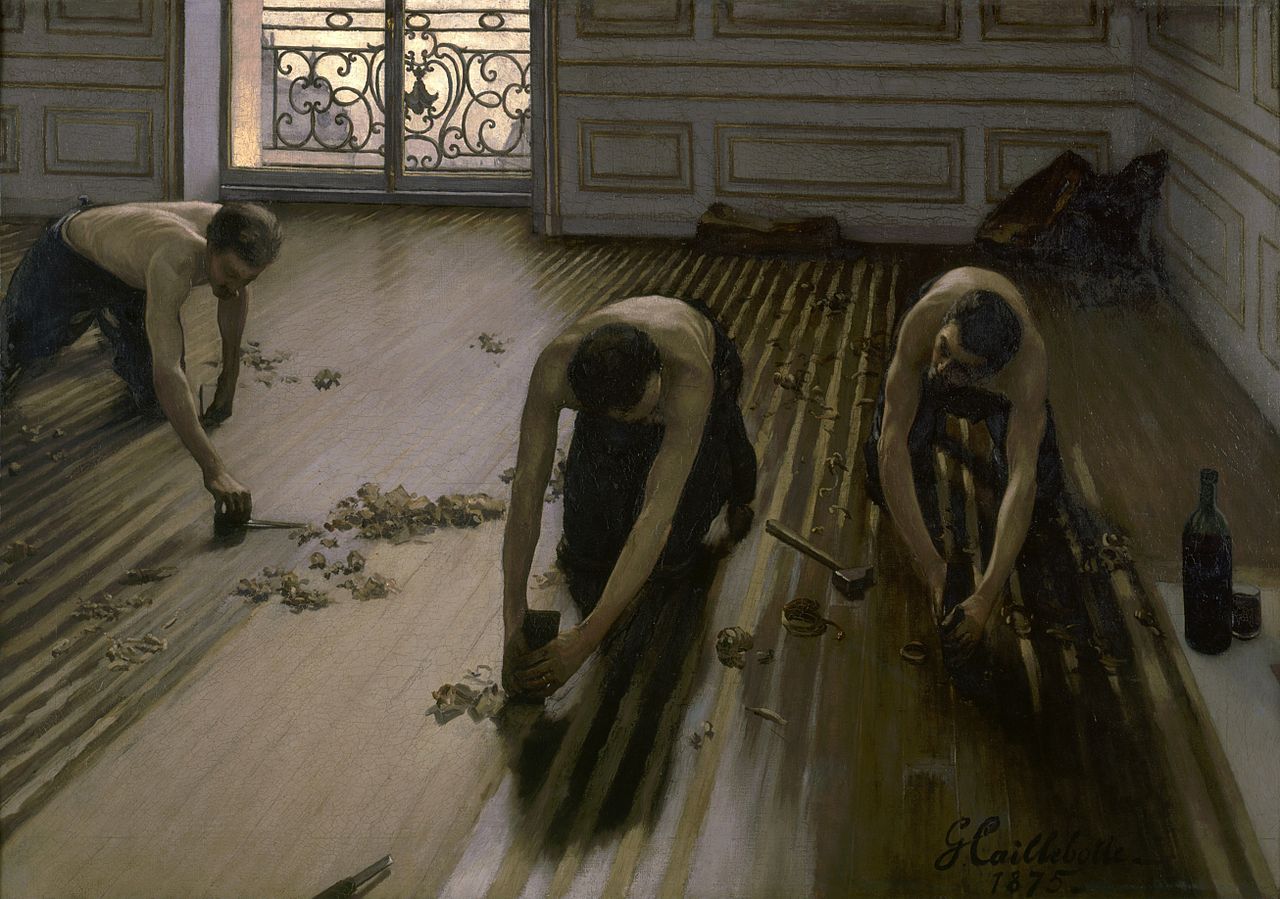
After this, I was getting beat down and hurried through the rest of the gallery. I did enjoy the works by Seurat and Cross and one in particular by Caillebotte (whose lesser works were featured at the Marmottan) with the guys refinishing a floor, The Planers.

Out of energy, I whipped by all the crappy Degas and Renoir that everyone loves so much, leading me to wonder if look like all those folks I get so annoyed at, racing through the galleries without actually looking at the works. In my case, I'd like to think it's because I've been there, done that, but to them, I must look like the rest of the heathens, sigh.

On my way out, I noticed a small painting that resonated enough to stop me. On inspection, it was another Manet. Subject? Yep, Berthe! Just a study really, but even as I was on the move, it caught my eye. Seriously those two...

Thursday, January 31, 2019

DAU: Refund Required

What follows here is a copy of the email I sent to the organizers of the DAU exhibit, which, as both readers know, was a complete and utter disappointment to me.

Greetings,

My apologies for writing in English--I confess that while I can understand and speak French to a limited degree, I am unable to write with any certainty. I hope you will understand.

I also hope you will understand why I am writing to request a refund. I signed up and paid for an unlimited visa to the DAU.

My first inkling that this might have been a mistake came when I went by the visitor center at Chatelet on 24 January, when the show was scheduled to open, only to find that it had been postponed. In fact, as I looked at the two venues, I could see that they were still struggling to get them open--workers furiously working on the doors and scaffolding still up at the Theatre du Chatelet. No worries, I thought, as I was not scheduled to receive my 'visa' until the 28th. I had hopes that the technical difficulties would be worked out by then.

I came back to the visa center at the appointed time--thirty minutes early, as advised--and received my visa without delay. A good sign, I thought. I asked if both venues at Chatelet were now open, but was told that only one, the Theatre de la Hotel de Ville was open. The look of alarm must have registered with the clerk--she asked me if I would like information on how to receive a refund. Thinking this was a bad sign, I said, yes, hoping for the best but preparing for the worst.

Well, the worst is what I got. I went into the Theatre at my appointed time and was immediately surprised to see that workers were still everywhere, and that the venue looked, at best, half-finished. I had, per instructions, left my cellphone at home, expecting to receive a special device that would guide me through the exhibit. The instructions made it sound as if this was the key to my 'personal experience' that would be created from the rather invasive questionnaire that I filled out online as part of the registration process.

Well, once inside, I could see no place to obtain this device, and when I finally asked a rather harried young man about it, he explained sheepishly that the devices were not available yet. Asked when they might be and where I could expect to find them, he could only say that he didn't know.

I found my way into one of the (only) functioning parts of the exhibit, a film screening in a large and virtually empty auditorium. There was a indeed a film being shown, but the sound was so poor that I could not hear, let alone follow the dialog. And the film itself was unremarkable--poor lighting, awkward camera angles and a general lack of any action. This I might have forgiven if, as I say, I could hear the dialog. After watching this for about ten minutes, the screen went blank and another harried young man came up to tell me that the film had experienced 'technical difficulties'. Asked when it might resume, he simply shrugged and said he didn't know.

Ok, fine. I went back out into the exhibit space and stood in line to use one of the silver film booths set up on the mezzanine. A few minutes into the wait, yet another harried young man approached those in line, explaining further 'technical difficulties' had rendered most of the viewing booths inoperable. A few were working, he said, but the wait (after one filled out some sort of waiver) would be forty minutes to an hour. I left the line after hearing this, thinking with my 'unlimited' visa, I could just come back later. The woman in front of me, with a three hour visa, had no such luxury and elected to wait. One hour later, I walked by and she was still waiting.

I went back down the the ground floor to begin exploring the rest of the exhibit, but increasingly found this hard to do because there simply was no exhibit. I tried to enter the 'Brain' segment but was told by a rather surly guard that it wasn't open.

I retreated and opted to explore the 'Future' segment. I went into the stairwell and walked up several flights, eventually ending at a door with some indication that the 'apartments' were on the other side. I asked if this was the case, was told yes (ah success!) and went in. The 'apartments' were nothing less than a joke, small rooms 'furnished' with junk items that were clearly picked up from a garage sale and placed haphazardly on tables and dressers. It had a depressing 'Soviet-style' air about it, but more like what a young French millennial thought it might look like. Just random and sad. In one room, to which I was not allowed access, I could see an amazing 'Soviet' Macbook on the table--who knew, eh?

And in one of the rooms, someone had cut up an onion, presumably with a spoon, given the look, and put pieces of it into some tin bowls, like this was supposed to be dinner. I thought perhaps the intent might have been to introduce the smell of onion into the air, to add 'authenticity' to it, but this, like so many other aspects of the display, seemed to be the result of laziness (at best) and outright deception (at worst) and had only the effect of making me wonder who had even bothered to do this. No doubt, someone who was thinking of lunch, and only wanted to be done and gone.

In another room hung a tapestry, with a crude representation of what I assumed was supposed to be a family--a man, a woman and a child. I knew of their sexes at least, because each of the figures was adorned with crude but very obvious genitalia. I can't read Russian, of course, so I don't know what the saying or slogan was at the top, but I found myself wondering where in the world someone had found this and why they thought it was something that a typical Soviet might have on their wall. Oh, and from the looks of it, this was supposed to be a child's bedroom, with a stuffed bear and some games scattered about to give us clues about what the child might have been up to before being escorted out to the gulag. I can't help but think of that poor child, staring at the graphic tapestry, clutching his little bear hoping for some kindly storm-troopers to come and rescue him. I know life was bleak for the Soviets, but this little tableau had obviously no connection to the real world. Just junk collected and assembled in no order and with no meaning.

I left the apartments and asked the young woman standing outside (also, yes, harried) if they were still working on the displays. She said, no, except for a few details, this was complete. I think she saw the look of dismay on my face, but I opted not to tell her what I thought of it. My question really said it all.

After this, I wandered up and down the stairwells, searching for but finding no other content whatsoever. Looking for 'Animal' took me up five or six flights of dilapidated stairwells (which were not designed to reflect Soviet grimness, but instead reflected the laziness and incompetence of the designers of the show) and arrived at a dead end. A trip down to the bottom of the stairwell where I hoped to find 'Motherhood' yielded only another bored looking guard.

I did manage to get into one of the operating viewing booths on the ground floor, after being told that the film being shown on that level was 'complet'. Given a number hastily scrawled on a piece of paper and shoved into a plastic holder, a young woman guided me to the booth. It looked like it had been built the day before, raw wood and tape holding it together. I suppose that was meant to reflect more of the Soviet grimness, but by now my charitable assumptions were gone and I knew it to be the result of poor planning and execution, not by design.

Inside I managed to view a few of the films, but like the experience in the theatre, the sound was bad (in spite of having headphones) the film quality was poor, the camera angles were awkward (often lingering on the person who was not speaking) and often the scenes were obviously staged, or part of some introduction being given to the 'actors'. Nothing useful in terms of emotion or the experience were presented--it was as if instead of trying to edit or select interesting content, they decided to simply 'use' it all. The grid presentation was unhelpful and had the look of some crappy porn site, with the viewer being required to select the clip based on the tiny hint given on the thumbnails. In this booth, there was an iphone, shoved into a wooden base, and on it was the message 'swipe to continue your experience'. This yielded nothing but a view of some unknown person's face, and nothing happened.

The only functioning parts of the exhibit seemed to be those designed to make money: the cafe and the gift shop. The cafe was manned by at least a half a dozen bored baristas--bored because there were no customers, and the gift shop had little to offer other than postcards and glossy photo books. Most of the shelves were lined with canned goods, most of which had no labels, as if, not having a sufficient supply of actual Soviet canned goods, the staff had made do with modern cans of tuna, disguised as 'Soviet' by a lack of label. I felt sorry for the wax figure of a woman by one of the shelves, forced to peer over her glasses at this tawdry fake display for eternity. At least I could get out, and I did, right away.

I did take the time to talk with a young woman at the entrance, who was very kind, but clearly frustrated at having to tell viewer after viewer that yes, this was all there was to see. She made it sound like more content would becoming, and judging by the number of workers on sight (at least double the number of visitors) they were certainly up to something. And don't even get me started on the faux 'janitors' wearing white jumpsuits and dragging around dry mops. I hope they were well paid, for a more boring and potentially degrading job I cannot imagine.

If I have bothered take the time to write this extended review, it's because I had such high hopes. After all, this is Paris, the 'big leagues' so to speak, where one must bring their best game to succeed. I can't help but think of the concurrent fashion shows--can you imagine if Karl Lagerfeld (for example) put on such a pathetic show for Chanel?

By contrast and for comparison I hold up the show earlier this year at the Palais de Tokyo by Tomas Saraceno. This was an amazing show, visual, tactile and engaging. At every turn was something new, interesting and exciting visually and intellectually. This is sort of art I expected to find at DAU, and if you've read even a portion of this email, you will know that I did not. I have refrained from publishing an extended review like this, limiting my comments to a few on Facebook, but if you've read the reviews in the New York Times and Le Monde, you'll see that my words are not the only critical ones and would, and would, in any case, never reach an audience such as theirs. Ironically the photo that accompanied the Times article came from the exhibit itself and neatly sums it up: Betrayal.

Comparisons to the botched Frye Festival are perhaps unfair--I do not think the organizers of DAU intended to defraud, but the result is much the same. A lot of people spent a lot of money on this, and you would do well to start refunds as soon as possible.

Wednesday, December 5, 2018

On Art

Art is human, the rearrangement of light matter (more on dark later) by humans.

This is an intentionally very broad definition.  This means that thought is art. In fact, it was the first art, a manifestation of what makes the human experience unique among life forms on this planet: consciousness. The fact that we alone possess this trait makes us unique is the basis for concluding that art is human.

If we begin within the brain and move outward, we can conclude that every action we take results in art. Our breath, our footsteps, our lives and deaths are all art. Of course, this means that most art is invisible, or at least so ephemeral as to go unnoticed--marks in the sand on the beach. Most art is never seen, lost in the very moment of creation.

This broad definition opens up the vector of thought about art to allow for more important questions than 'what is art?'. There are many such questions, some having to do with the purpose, or the value, or the need for art.

The most important question is one I have grappled with since I saw a painting by Monet in the Fitzwilliam Museum in Cambridge in 1976. I had never seen anything like it in my life, and thanks to my parents, it was hardly the first time I'd seen a painting. I stood in front of that painting for a long time--so long that my parents had to come back and get me.

Why? For a long time, I had no idea, nor did I think of it much. A couple of years later, I took a course on aesthetics and started the long process of thinking about beauty and art and the intersection of those two ideas. What is beautiful art? As so many have said, 'I'll know it when I see it' certainly applied to me, and I really tried to figure it out. What happened to me in front of that Monet?

It's happened to me many times since then, of course, which is why I now love going to museums and seeing art, new and old. It doesn't happen often, but when it does, when I am arrested by a work of art and stand transfixed by it, the feeling I have is a delight, unique and familiar all at the same time. A rush, brain on fire.

That rush is resonance. It is like a pair of tuning forks--one vibrates and the other responds. They resonate. This is what happened to me in 1976 and what happens every time I see good art. I resonate, I feel something physical that is so sensitive and unique that it can only be measured by human consciousness.

Physically, that force, that exchange of energy during this resonance is so small as to seem inconsequential, but the fact is that it is an exchange that is non-zero. Something happens, not always and not to all, but sometimes and to some people, there is an exchange, a 'real' physical exchange of energy when observing a work of art. Consider that the case of the Monet, it was light that conveyed that resonance, just a few photons, but enough to cause a chain reaction in my brain, leading to this very essay.

The question of what is beautiful art is misleading. The intersection of beauty and art is an interesting trap. I do not equate resonance with beauty because it leaves unanswered that key question of the location of beauty: In the work or in the viewer? It's a trap because the answer is: It's in both. And that seems too simple, an answer with no depth, like Schroedinger's Cat or the Particle/Wave duality. It's an answer but a non-answer.

So, my question is different: What is good art?

At first, this looks like the same question: beautiful, good, aren't they the same? Isn't beautiful always good and the other way around? A couple of thought experiments can set this assertion aside, but there is still the question: What is good? Specifically, what is good art? And why does matter that good is not always beautiful?

It matters because without trying to substantially define either good or beautiful, I can address the question I came for: Why did I resonate in the presence of the Monet? The answer is that I thought it was good. I may, at the time, have thought it was beautiful, but looking back, I realize that it was good. Or at least I thought it was.

The difference here may seem semantic, but trying to decide why I think a work of art is good. Basically it's a simple as admitting that you like it. In this way, I can see a painting and say that since it does not resonate with me, it's no good. Or at least, not good enough for me. This allows for the fact that some people resonate with some works and some resonate with others. The fact that these overlap fairly frequently is why we have art galleries and museums.

Museums in particular are evidence of this. The history and basis of museums is theft. We steal what we think is good and put it on display. To me, many things in museums are no good, but the fact that they are there is because somebody at sometime thought they were good enough to steal.

I think that when we talk about what makes a work of art beautiful, we are actually talking about what is good. Good is what we like. The lines, the color, the subject. We can say 'I love this line, or this color or this subject'. It's personal, but then, that's what we are experiencing, a personal resonance with art. It's always personal, even if we share that feeling with a million people.

Good art is what you like.

Friday, May 2, 2014

The Future of Photography

What, if any, is the future of photography in the digital era?

Photographs haven't been with us all that long, but they may already have become virtually worthless. When they were new, cameras were used to document many things that had never been recorded previously, and photographs were, in and of themselves, works or art.  Over time, with the help of folks like George Eastman, photography became the province of the masses, and photographs were reduced to 'snapshots'.

Still, some of these snapshots were still in an of themselves works of art, even if they lacked some of the original rarity of the first photographs.  Admittedly, many were nothing more than pictures of people in poses and places that seemed scene-worthy.  And while many of the pictures of people and even more shots of scenery ended up being important documents about the time and place they were taken, most of the photographs through the end of the 20th Century were destined to be lost forever, trapped and simultaneously falling out of old leather bound books with crumbling black paper pages and fading gold ink.

These albums are in hundreds of thousands--if not millions--of bookshelves, in closets, attics and basements in virtually every corner of the earth.  It is amazing to think about how many photographs have been taken since the first daguerrotype, and even more amazing to realize that most of these are simply gone, victims of of nostalgia, neglect and finally just basic chemistry.  What hasn't been thrown away or put away has likely simply faded away.

Too many pictures

But if we think there were a lot of photographs taken in the 20th Century, no matter what that number is, it will be dwarfed by the number of digital photographs that will be taken in the 21st century.  In fact, I'd venture to guess that even today, just a few short years after digital photography became so widely available and used, there have been more photographs taken since 2000 than in the approximately 150 years before that.  And we are just getting started.  By the end of the century, the number will be several orders of magnitude larger with no signs of slowing down.

Of course this excludes end-of-the-world scenarios, including those that expect the world's electrical grid to fail--and thus result in the irreversible loss all of digital files, including photographs--not because I don't think this will happen, but because for this particular thought experiment, we need to suppose that the taking of pictures goes on uninterrupted for decades and even millennia.

That's because I want to think about not just the number of photographs, but I want to contemplate what will happen to subject matter itself in such an extreme situation.  In other words, if we keep on taking pictures at the rate we are today (assuming no increase in the rate of increase) will there be anything to take a picture of in 3001?  Will we have taken every picture of every flower and bee and mountain and sunset?

Why bother?

It's natural to say, no, of course not.  There will be a new sunset every day in 3001, and plenty of bees and flowers and cats and oh yes, each other.  There will be no way we can have taken every picture.  I can agree with this on one level--purely numeric--but on another--symbolic--I have to wonder what the point of taking pictures of those bees and flowers and sunsets will be as we go deeper and deeper into the new millennium.  Can we imagine a time when you don't need to take your own picture--just pick out one that you like and use it, make it your own.  When you need a picture of a sunflower, you don't need to take it, just take it from the net.

Of course, this is already happening, and the meaning of many photographs has been reduced to virtually nothing because of the ubiquity of the subject matter.  Even the now-famous 'selfie' has been diminished and demeaned by overuse, and it isn't going to get better in the next few years, that's for sure.  It's one thing to use photographs as documentary evidence, but quite another--and some would argue, rather useless--to use photographs as unique art objects.

Or is it? Will the value of art prevail in a world where reproduction is so common that originality is lost?  Can that even happen?

Three ways up the mountain

I think so.  In fact, I think we already have the evidence of what photography will become--as an art form--in the coming decades.  I have three examples to work with, all from friends who are photographers.  These are individuals whose work points the way for photography in the future.

Tom ~ Mosaics

Tom is a photographer who is also a painter.

Or perhaps he is a painter who is photographer.  We've had many discussions about this, because this chicken-and-egg conundrum is relevant to his work in particular.  He started off as a painter and turned to photography because it was easier to take pictures than it was to paint canvases.  So he began to take pictures.  And with a digital camera in hand, he began to take a lot of pictures.  But his instinct, his desire, was to make something more than just a photograph, another snapshot.  Meanwhile, the pictures began to add up.

At some point--and you can read about his whole discovery and process in a series of essays that he wrote as a result of our conversations--Tom found a way to bring these two processes--painting and photography--into a kind of synthesis: mosaics.

Again, I will defer to his description of the creative process to explain how this works and why he settled on this particular form at this particular point in his career as an artist, but I want to observe that his method points toward a way that photography can be used in a meaningful way in the digital era.  I can summarize his technique, I think, by saying that he uses individual photographs as brushstrokes in a larger whole that can be described as a painting.  Of course, it's still a digital image, but it has been transformed from a snapshot--or even a series of such shots--into something that is no longer 'photographic' but is more basically 'graphic', in the same way that a pencil mark or a brushstroke is a graphic.

You have likely already seen something like this.  The photograph of Lincoln, for example, that is made up of thousands of images of soldiers from the Civil War.  From a distance, say ten or twelve feet, the image looks like the portrait of Lincoln we are all familiar with, but get up close, within a foot or so, and you can see that it's really a mosaic.  What looked like pixels from a distance are actually photographs in and of themselves.  It's a clever trick, and it is an impressive display of the power of digital photography.  It allows for a layered experience, one where the viewer first sees one level and finds themselves drawn into a far deeper, more intimate place on closer inspection.

In many ways this is a long standing goal of art, specifically painting.  To show or hide the brushstrokes has been a debate among painters since first two people held a brush side-by-side.  One argues that showing the strokes invites the viewer into the world of the work's creation, after they have experienced the illusion of the image; hiding these strokes falsely denies the true nature of the work by pretending that the painter somehow didn't exist. The other argues that hiding the brushstrokes enhances the illusion, which is the point of the painting in the first place; showing how it was made would destroy the illusion and render the work useless.

This debate will go on, of course, but the essential issue, is that photographs can be pixels in an of themselves, and as such, can be part of a larger whole.  Right now, the practitioners of this art form are primarily focused on the naturalistic representations (like the Lincoln portrait) but the trend, in an artistic sense, is toward the abstract, or at least to the re-interpretation of naturalistic subjects.  When the pixels are photographs, is the resulting work a meta-photograph?  I prefer to think of it as Tom does, as a complex object, with nuances and suggestions that go far beyond a photograph or a painting, but combining elements of both forms.  This is how new forms are created.  This is how art evolves.

Chris ~ People

Chris is a professional photographer and a teacher of the same in a small private school.

He has been working as a professional since he was in college, shooting just about anything and everything for pay.  That means weddings, bar (and bat) mitzvahs, family portraits and even commercial properties and products.  Since he is now in his fifties, this means that he has managed to sustain himself as a professional for decades, which is no small accomplishment, considering how many things, small and large, go into a professional photo shoot.

In other words, he must be good.  And he is.  He is a careful and meticulous photographer, paying attention to the various elements like lighting, exposure and composition, but he is also a creative photographer, which means he sees and pays attention to many details that we--the viewers--might not notice, but which certainly affect our perception of the finished work.

These details have to do with people--specifically how people act and react when a camera is pointing at them.  Many people think that the camera is doing the work, after all it's right there, in between the photographer and them, but in fact it's the photographer who has the most do do with the outcome, especially when taking pictures of people.

Pictures of people are what Chris does best.  Somehow, he manages to capture something unique and compelling in his portraits.  You might say that he captures their 'essence' or their 'spirit'.  However you define it, the intangible quality is noticeable.  These are not snapshots, nor are they carefully composed still lives.  They are somewhere in between, and therein lies the magic of his art.

Lest you think it is easy enough to point a camera at someone and get a good photograph of them--that is, one that represents them in a way that you, as someone who knows them, will recognize, and if you don't know them, it will resonate with you anyway, because you know someone was there, in front of that camera, and that you can really see them, not just how they are standing or what they are wearing.  In fact, you might not notice any of that, as you are focussed instead on the person who's image is literally filling your field of view.

In this way, Chris' photographs of people point to one of the ways that digital photography can remain relevant in the face of an overwhelming crush of images. For no matter how many times we point the camera at a person, there always exists the possibility that we will see them in the photograph in a way that is more than simple recording.  We feel them as real people, living just beyond the frame, on the paper but in our head.

And what makes this difference?  The photographer.  No one but the artist can find this space.  Selfies will never replace portraits, and no matter how much someone loves you, if they don't understand photography, just pointing a camera will not result in a portrait.  It isn't just a mechanical process--it's an emotional one.  What we feel as an observer of a good portrait is the relationship between the photographer and his subject.  This can be timeless and eternal, which are the very qualities that we seek from good and lasting art.

Valery ~ Detail

Valery is a photographer who never thought she would be a photographer.

She was never all that interested in photography, in spite of the fact that her brother is a professional photographer and her husband has been an amateur shutterbug for many years.  He brought digital photography to the house and gave Valery her first camera, a hand-me-down that he had set aside for a newer, better model.  His interest was in the device, so despite the fact that he had taken many hundreds and thousands of photographs, very few of them held any interest for Valery (or anyone else, for that matter).  They were more snapshots, dinners, nights out and stuff around the house.

But when Valery picked up that same camera, a couple of transformations took place.  The first was for the camera, which had been used in a sort of straight-up point-and-shoot way that it was designed.  But in Valery's hands, the camera became a recorder of a world not often seen and seldom photographed: the world of detail.

Most of us look at the world around us as a pretty familiar place.  We seen things we recognize and take them for granted.  But how often do we really look at the things around us?  How much detail are we missing on a day-to-day basis?

The answer is, a lot.  In fact, we see so little in our everyday lives that it's fair to wonder if we really 'see' at all.  Mostly we just sail, swim or dig (pick your metaphor) through our lives, seeing enough to keep us from running into things and preventing other things from running into us.  It's almost like an obstacle course, and we don't really look at the obstacles as we climb over and under them every day.

These details can be natural, and most often these are the sources of Valery's inspiration.  Looking closely at a vine, for example, or a flower or a piece of wood or rock, Valery sees what we are missing when we step over them, or see them as a vague green, brown or grey blur that must be avoided.  But Valery doesn't avoid them.  She steps up closer and looks at them as if they've never been seen before.  This isn't hard.  Many things we think we've seen have really never been seen by us before.  I am talking about detail, the stuff that we see when we stop and look closely.

This is what Valery does in her art, and again, I think this points to a future for photography in the coming millennia.  The world is full of details, and our lives are made richer and more interesting as we see and understand this world.

The reach and depth of this particular approach to photography is both broad and deep.  There is so much about this very planet that we do not see, so much that we do not know, as intriguing as a photograph of the deep space field might be, the images of microbes and the world that they inhabit is much more fascinating and visually rich.  Images of our world necessarily resonate with us, and photographs of the detail can be a way to extend, enhance perhaps the experience of being in it.

Resonance

So, what do these three examples have in common?  What is it that forms the basis of photography as an art form in the 21st century?  The answer is not simple, but it may be paraphrased for the sake of remembering why we pick up a camera in the first place.

Photography is art, which is essentially about enhancing the experience of life.  It allows us to do much more than simply remember what we can no longer see with our eyes.  It allows us to see what we might never have seen at all with those same eyes.  We resonate with it and are changed as a result.  

Monday, February 18, 2013

Opening the Door

I was sitting in Kerbey Lane Cafe on Guadalupe on a recent Thursday, having lunch with my brother when a man came up to me and asked if I was an actor. I said no, but then he asked if I was interested in being in his film. He said I have "the perfect face".
Naturally I was flattered by his request, and just a bit skeptical, since I had no idea what kind of film he had in mind.  Curiously I didn't even ask.  What I did ask, to his surprise, was whether or not he would have picked Stephen, had we been sitting in opposite seats, since I have the idea that we look so much alike, but he averred that I was his choice.  
The director, a young man whom I'll call JP, told me he was an MFA film student at UT and this was going to a short film for a class he was taking.  He seemed nice enough and I was just egotistical enough to think that I could pull something like this off, so I said yes, I'd give it a try.  He was pleased and offered me a notebook in which I wrote my email address.  He said thanks, we shook hands and that was that.  I had no idea what to expect.  To be honest, I was excited and flattered, but really didn't think it would come to anything.

Monday, July 25, 2011

Keep Austin Surreal

This Saturday Maddie and I participated--along with about thirty or so other volunteers--in the second installation of a piece by Steve's public art group, Art on the Way.

Entitled, "Keep Austin Surreal" this mural was created with colored plastic cups locked into a chain link fence.  It is the creation of Austin artist Gary Sweeney, and it is located on South Lamar, attached to the fence between the Bicycle Sports Shop (which is a sponsor of the exhibit) and McDonalds (which is not).


The first ATOW sponsored work, entitled "Barton Barriers" garnered a good bit of attention, due in no small part to a column by 'cranky old man' John Kelso in the Austin American Statesman.  It will be interesting to see if this shows up on anyone's radar this week.

Interestingly, after all that, I actually failed to notice it this morning as I was reading and riding to work on the bus!

Thursday, December 30, 2010

Don't Make That

These days, it seems fashionable to be 'anti-art'.

It seems that no matter what art it is or where it is placed, somehow, someone will be against it. But what does that mean, to be 'anti-art'? Is this a new phenomenon, or is it something ancient, built-in, so to speak, to society itself?

I tend toward the latter explanation because while it is sometimes fashionable to be iconoclastic, it has always been safe to be anti-art. The most common example of this is trite.

"That's not art. My five-year old could have done better than that!"

While uttered often in our era, I suspect that down through time, there has always been some observer off to the side muttering that very sentiment, even stretching back to the Neanderthals. Critics, even cavemen, have ever been so cruel. Another, less articulated but still prevalent attitude is more direct.

"I don't care what you call it. Stop. Don't make that."

This is most often directed to artists at the extreme edge, whose position there is to elicit that very response, but it is what is really at the core of most objections to art. If being anti-art is somehow seen as being pro-order (or anti-anarchy to double down on the negative) then it is a rather common feeling, I suspect.

Many people feel--and, perhaps, have always felt--that art and artists have simply run away with (from?) the rules of society. There is a prevalent feeling that for most people, most art is no better than graffiti, and certainly is no less harmful to society. Art, like graffiti, is a sign of decay. Art is anarchy that threatens the order of society and some people think that they are defending not simply their opinion, but their very way of life.

Sometimes it's tempting to think this way. It'd be much easier to reject art than think about it. But common sense and some reasonable humility are in order. When we see ourselves as the last bastion of civilization, it's a sure sign we are overreaching.

Tuesday, August 31, 2010

Losers Weepers

Finders keepers.

It may be one of the very first unwritten rules that we learn. I learned it from a classmate in kindergarten. What looked like theft to me was, someone explained, actually fair. Somehow, the sing-song delivery of those magic words seemed to make the act of appropriation more like an innocent windfall rather than the more contradictory reality that it was.

The contradictory part is not omitted nor even disguised. Losers weepers pretty much says it all, but this we conveniently choose to ignore. The thrill of finding something overrides the certain knowledge that anything found must have been lost, by someone. Using notion that it was simply left there for us to take as a defense isn't even a necessary if we invoke the finders keepers rule. We can simply take. And we do.

When I was a teenager, I was fascinated with Egyptian antiquities. I won't claim to have been offended or in any way concerned with the ethics of archaeology or the provenance of art. I loved the gold and copper sarcophagi and the mummies therein. I spent hours staring the blue and gold scarabs, and golden treasures looted from the tombs of the Kings of Egypt.

But I didn't actually think of them as looted. I read the stories about the discovery of Tut's Tomb, and even managed to visit the Metropolitan Museum in New York during that King's famous road tour through the U.S. back in the sixties. Thanks Lynda.

It was Lynda who first informed me about the shady world of art collecting. One of her most beloved pieces of art in the world was actually a collection of sculpture fragments taken from the Parthenon in Athens. Known as the 'Elgin Marbles' after the British explorer who brought them from Greece to England, these are some of the finest examples of Greek art that we have in the world today.

Lynda, of course, had read a lot about the Elgin Marbles long before she lived in England. But one of her first excursions after arriving in 1975 was to the British Museum to see those statues. She often talked of the experience of seeing for the first time as being a very emotional and dramatic one. In spite of the fact that she was an abstract expressionist painter, she was deeply influenced by classical art of all kinds. Lynda loved art of all kinds. The Elgin Marbles just happened to be one of her first loves.

But Lynda also made it clear, whenever she waxed rhapsodic about these sculptures, that they were looted. She had to turn in some very tight circles to justify the looting, but she was enough of a realist to know that just because you 'own' something doesn't mean it's yours. Long before the talk of 're-patriating' art became fashionable, Lynda knew that someday the Greeks were going to come calling for their 'Marbles.'

As a student of art history, I too can turn in some very tight circles to justify my love for looking at things I probably shouldn't be able to see. It's too fascinating to turn away, so like rubberneckers at a crime scene, I leer and stare and soak up all the information I can. I am a part of the problem.

But, should we just stop archaeology? Just leave everything where it is? Return everything in museums?

Ok, so those are rhetorical questions. Suppose that the British Museum is seriously considering returning the Elgin Marbles. Would that make any difference? What about the Egyptian collection? The Sumerian stuff? Isn't everything in every museum simply looted or stolen?

The answer is yes. But are we seriously going to give all that stuff back? Not likely. To whom? No one knows.

Although the great age of museums is drawing to a close, even in response to the most dramatic weeping on the part of the losers, most of that stuff will stay right where it is.

Sunday, March 21, 2010

Art on the Way: The Barton Barriers


Some folks are wondering what the heck this 'Art on the Way' stuff I've been talking so much about. Here's the story so far:

My brother Steve, who is about 13 years older than me, is a sculptor. He moved to Austin a few years ago to help me care for Lynda during her passing and he decided to stay. He opened up a sculpture studio, which he calls Atelier 3D, to make a living by teaching sculpting classes. He has done pretty well so far. He's managed to keep the operation going while working on his own body of work.

Over the years, he has worked in almost every medium there is, from steel, wood and particularly ceramics. He made a whole series of figurative sculptures, which he called 'Vens' (short for Venus) while he was in California.

Then when he first got here, about three years ago, he started making what he called 'book shrines' which were essentially elaborate ceramic boxes or display cases for his favorite books.

Currently, his work is with what he calls folded glass. He takes automotive glass--it has a layer of plastic sandwiched between two sheet of glass--and crushes it under the wheels of his truck. This causes the glass to crack into intricate patterns, but it doesn't fall apart because the plastic holds it together. Then, he folds the glass into abstract shapes and links the pieces together with polished aluminum bolts, buckles and ties.

Then, about a year or two ago, he came up with an idea he calls "Art on the Way". The idea behind this project is that there are many unused public spaces in and around town (Austin, but it could be anywhere). These are small bits of land that developments and streets and utilities have rendered useless for anything other than just taking up space. For example, when an intersection is enlarged, sometimes there will be a tiny triangle of land that is 'left over' when they finish with all the pavement, curbs, etc. So it just sits there. Sometimes there is a bit of grass or some scrubby trees on it, but a lot of times it's just a patch of dirt.

Steve's idea is to use these discarded and unnoticed spaces as places to put art, specifically sculpture. Now, we do indeed have a good bit of public sculpture, but it's just the sort of thing you would expect, like a monumental sculpture of a local musician and another one of a giant abstract bat. The musician was Stevie Ray Vaughn, by the way, and he was indeed one of the greatest blues guitarists ever (he died in a helicopter crash a number of years ago), so his sculpture is very naturalistic. The bat came to Austin because we have one of the largest Mexican Freetail Bat colonies anywhere in the world living right under a central bridge here in town called the Congress Avenue Bridge.

All that is to say that sculpture in Austin is and has been so far a relative uninteresting affair. Steve's idea is to change all that. So, his first project was something completely different. He decided to make a monumental sculpture out of something we see so much of here in the US that we really don't 'see' it at all any more: the street. Specifically, he hit on the idea of using traffic barriers, something so ubiquitous that we almost never really notice them other than to avoid running into them. Now, there are a lot of varieties of traffic barriers, ranging from cones to barrels to Yodocks.

Yodocks?

These are a particular type of traffic barrier, made entirely of that nearly-indestructible plastic that they make the cones and barrels out of, but in a rectangular shape, and hollow so that it can be filled with water or sand for stability. The advantage to these is that they are cheap to make and easy to put in place. They are not too hard, so if someone runs into them, the damage to their vehicle is minimized. They are often linked in miles-long chains on the highway, dividing two lanes in construction zones. Again, we see them all the time. So much that we no longer really see them.

Steve's idea was to put these Yodocks up off the road in a sort of whimsical arrangement that is reminiscent of Christo's many works. He envisioned a long strip of them, sprinkled, as if by a giant, along a bit of unused and unnoticed land on a street in South Austin called Barton Skyway.

Here is the location: Barton Skyway & South Lamar

He needed more than just a few of these Yodocks to pull this off, however, so he called the compnay to see if they would be interested in loaning him a few of the barriers for his art project. He suggested that it could be a great public relations opportunity for the compnay, and they agreed! In fact, they loaned him 37 of the barriers. Ordinarily, the company rents them for like $50 apiece per day, so this was a pretty generous contribution. Of course, they saw it as a publicity stunt and even had a reporter from the 'Construction Times' (or something like that) on site taking pictures and making notes for a trade mag story.

Speaking of contributions, Steve also planned to raise money for the project by applying for funding from the City of Austin. The City has a special fund set aside by ordinance to provide for art in public places. The money comes from the construction permits, and is intended to provide arts funding for new buildings in particular, but it is available to fund public art anywhere in the city. The two sculptures I mentioned above were also funded in part by the City.

There's a complicated application process and the projects have to be reviewed and approved by some kind of supervisory board, but Steve navigated the entire process and emerged with $4,300 grant. Of course, he had to turn around and pay the City about $700 of that for the necessary permits, but at least he got something.

He also raised money from other people, nearly $5000 in total. He went to the neighborhood association to get their approval and did. They even agreed to help with the installation, volunteering to help build it and provide the water that went to fill all those barriers. Steve went to the businesses around the site and got them involved as well. With all that support and a corps of willing volunteers, he set about making it a reality.

About a week ago, Steve, his girlfriend and collaborator Heather, and about forty or so volunteers, of which I was one, went to the site early in the morning and toiled all day to push, place, stack, strap and fill all 37 of the Yodocks, creating a monumental work of art:

As you might imagine, it was not universally well received. Many people who stopped to watch us work siad in no uncertain terms that they didn't like it and thought it was a waste of time. Well, fair enough, but at least it was our time that we were wasting.

And, it seemed like the discussion would stay in this area--that is, maybe it's a bit nutty but harmless all the same--until a local newspaper columnist picked up on it and wrote a 'review' that ran in the paper and appear online the following Monday.

John Kelso writes a kind of humor/local flavor column three times a week for the Austin American Statesman. For years he's written about 'good ol boy' sorts of things, like ugly trucks and old dogs. To be fair, he does often write about local art and happenings, especially if they are of the pseudo-weired variety.

Steve's piece, which bears the title "Barton Barriers" by the way, fit right squarely into Kelso's sweet spot, so to speak. Kelso made no bones of the fact that he didn't like it, which was a fair appraisal, since not everyone can be expected to get the joke, even humor columnists.

The problem that I had with his 'review' had to do with the fact that he made mention of the money Steve had gotten from the City as a reason for disliking the piece. Though he didn't actually do make the claim himself, Kelso left the door open for the 'wingnuts' to claim that this art was just another waste of taxpayer money. A boondoggle, they called it.

I couldn't let this go, so I wrote Kelso directly. And to my surprise, he wrote back! Not just once, but a couple of times. He was nice enough about it and, darn it, right about the money.
I took umbrage but I really needn't have. Kelso gently pointed out that the first rule of journalism is to mention the money, and that the wingnuts will come out no matter what you say or do. "It's what they live for" he observed sagely. Alas. Heavy sigh.

Even though I know that the real first rule of journalism is to spell the names right, I have to agree with Kelso about our common goals, journalists and artists: more readers/viewers.

Not everyone was as observant of human nature as Kelso. Others played it straight, missing the joke and playing into our hand simultaneously, thankfully with no hint of the irony.

Really? A $4.3K boondoggle? When senators and representatives routinely waste hundreds of thousands and even millions or billions (that's M & B!) of taxpayer money, now that's a boondoggle! This was just a little joke.

Except that the wingnuts don't 'do' jokes. Everything is serious and everything is political. It started with the comments to Kelso's story, then moved to the blogs, then the TV and Dallas radio stations all jumped on the bandwagon, each with the same 'fraud busting' theme. Even if we happen to live a fairly liberal city, it is still Texas after all.

Silly stuff. But as it turns out a lot of people are actually taking notice of the work.

Any publicity is good publicity, right?

Wednesday, June 3, 2009

Archiving Their Art

Lately I have been--with the assistance of Valery and Madelaine--engaged in the task of cataloging and archiving Lynda's artwork and Bill's photographs. What I have discovered as part of this process is that Lynda was far more prolific and significantly more interesting than I had realized, whereas Bill's work was far narrower in both it's volume and scope than I had expected.

Lynda's work was all around me for many years and still is, so it should come as no surprise that she was remarkably prolific. As I undertake the task of archiving her paintings, however, it becomes obvious in a very physical sort of way.

After the fire that essentially destroyed her studio in 2005, we faced the arduous job of sorting through all of her now blackened materials and supplies, stacks of drawings and the dozens of soot-covered canvases that had lined the walls of her one-room studio and the halls outside. They were stacked against the walls and filled one third of the studio. Those that were not too badly damaged we removed the paintings, drawings and boxes of supplies to a storage unit. That was a job for Stephen and me, as Lynda was clearly not up to the task, physically or emotionally.

The supplies were not simply not salvageable. It was heartbreaking to throw away all the paint, brushes and pencils that she'd collected for years. We filled sack after sack with the soot-covered remains of a lifetime of craft. I saw pencils that I recognized from days when her 'studio' was nothing more than part of the kitchen after supper, simply thrown away with a dozen others. It's just stuff after all, but it was impossible to escape the sense of loss.

Though there was very little serious damage to the paintings, that damn soot was, to say the least, insidious. It was--still is--everywhere. It had settled onto the top edge of every painting; those stacked in the back merely had soot there, while those on the wall were subject to the forces of gravity and thus came out covered in a fine black film that still obscures them. it is enough to notice but not enough to justify destroying them.

Destruction is, I guess, a relative term. Certainly Lynda--natural pessimist that she was--held out no hope for salvaging the body of her work, but I was convinced otherwise, and still am.

Many of her drawings--especially the ones actually sitting out on the table or in a bin by the wall--were beyond hope and thus were lost to the trash bags. Other drawings--the majority, thankfully--that were piled up in books and journals were untouched.

Most of the paintings offered some hope of recovery. We gave it our best effort, in any case. Over the next six to eight months or so, Lynda and I spent several hours on Sundays cleaning each and every painting with baby wipes and paper towels. Some didn't make it. Most did, however just to remain in storage from that point on.

They are still in storage, but as I said, we are now engaged in the process of archiving her work. This means one last pass through the stacks of canvasses. Our goal is to move the entire batch into a smaller--thus more affordable in the long run--and climate-controlled storage unit.

Before that can happen however, we have to photograph and measure each work, wrap it first in plastic and then in paper to protect it from the elements and insects. Each painting takes about fifteen minutes to half an hour to process. Even though we've already done twenty-eight of them, we still have more than seventy five canvasses to go.

Bill's photographs, on the other hand, pose less of a problem when it comes to the issue of archiving. For one thing, although there are far more photographs of Bill's than Lynda's paintings, the photographs are not nearly as compelling as objects worth the effort of saving and thus may be sooner lost to history.

Why? In the box of his photos that was handed down to me after his death in 1981, although there were literally dozens of series of photographs that he took over the years, most of the fading Kodachrome images have simply lost their reason for being. Without him here to explain to us where and why he took these photos, the images are vapid, cluttered and ultimately, meaningless. Honestly, unless someone appears in the image that I can recognize there is no reason I can think of to save these fading pieces of paper.

The negatives are another matter. These are being carefully sorted, numbered and saved. For now that's all I have the time or inclination to do. Eventually they should be digitized, cataloged and properly archived, but that is a task I am not sure I am up for. At that point I'd be faced with similar questions about what to keep and what to throw away.

Even though digitizing Bill's negatives minimizes, literally, the need for culling the work, surely not all of them deserve saving. Is it really possible to imagine a situation in which all of his work might be considered a valuable archive? Does his body of work really constitute sufficient value for the future in the way that Lynda's art might?

This is not to say that Bill was not a good photographer or that Lynda was a great painter. This is an observation about my encounter with my parents' art as extensions of their personalities, even and especially now, after death.

I am surprised to find how little of Bill's vision was captured on film and how much of Lynda's still emerges from soot-shrouded paint.

Monday, March 2, 2009

My Mistake at Moissac

In her most interesting and challenging book, On Beauty and Being Just, author Elaine Scarry asks her readers to contemplate a mistake they have made about beauty. This is mine.

What sort of mistake is this? Whether it be seeing something one thought was beautiful and now no longer finds so, or realizing that something was beautiful when one didn't think it was beautiful before, this mistake is not something most of us would ever think about, since it would seem to pass so fleetingly as not to be noticed. Nor would it be something to be noticed by thinkers other than those who have already taken up the difficult question of the nature of beauty. But for those of us who have long pondered this subject--and I count myself among them--Scarry argues that this mistake is both inevitable and key to our perceptions of what it beautiful and why.

To be sure, Scarry's question to her readers is not so specific as I've just cast it. She asks the much more general--and therefore, engaging--question: "What is an instance of an intellectual error you have made in you life?" She makes no mention of beauty here, but perhaps conditioned by the subject of the book in hand, as I naturally and immediately thought of an example of such an error, it had to do with my perceptions of beauty.

In keeping with her suggestion: "It may be helpful if, before proceeding, the reader stops and recalls--an as much detail as possible--an error he or she has made so that another instance can be placed on the page..." this short essay is an effort to record that moment and thus use it as she suggests as I seek elucidation of beauty in her dense and engaging prose.

It is in part because she was so prescient as to know that "Those who remember making such an error about beauty usually also recall the exact second when they first realized that they had made the error." The resonance I feel in reading these words is no coincidence. Scarry has hiot upon something important here.

In fact, I do recall that exact second, and it was the very second in which I began contemplating beauty; it was the beginning of a lifelong quest to understand. The real revelation was profound to me indeed: If, I reasoned, I had made this mistake, what others have I made? Will--can--learning illuminate this dark world?

My moment--my mistake--was at the Abbey Church of Moissac, located in south-central France on a cold and windy November day in 1976. We stepped out of the bus on which we'd been riding all day just as the sun was beginning to set and crowded around the elaborate carved stone portal that filled the arch over the broad double-doors to the church.

Sadly, my first thought as we arranged ourselves about the portal so as to both have a view of it and hear the words of the Professor as she lectured on the history, style and meaning of the sculpted relief we were finally gazing upon was this: "That's it?"

I didn't say this, of course, not just because I would have been embarrassed to admit my ignorance in front of my peers or worse, the Professor whom I so admired that I had changed my schedule mid-semester just to be in her--this-class, but because I really wasn't sure if I "got it." For that matter, I wasn't so sure I'd ever "get it." In my mind's eye, the scene is recalled in perfect clarity. I even have a sort of 'telescopic' vision of the very figure that I was staring at when I had the revelation, but I must first put it in some sort of context.

For one thing, I recall standing practically in the street. It didn't help that the church was undergoing renovations which left all but the very portal we had come so far to see covered with complicated scaffolding, but that wasn't why were were forced to stand on the curb and even in the street to get a good view of the 12th century carved stone portal. It seemed like the portal simply opened out onto the street. Actually, the doors opened onto a very narrow sidewalk which of course allowed access to the church, but did not offer entrants much opportunity to see the magnificent art array above their heads as they came in.

However, as students taking Art History Professor Francesca Weinmann's Introduction to Romanesque Art course, the thirty or so Americans from the American College in Paris arranged in a semi-circle about the portal that November day were likely the only ones to be interested in the portal enough to seek a good vantage point from which to see it.

This being my very first time to see a Romanesque church and even to really gaze upon the art from that period and place, I was just becoming accustomed to the way in which the very old is incorporated with the new and very new in European towns and cities. So, the sight of the important portal simply being ignored by the populace took some getting used to. Later, I realized that the art wasn't actually being ignored, it was simply being accepted as part of the ever-changing tapestry of urban life. The people who passed it by or used the Church knew it was there; they had often seen it and now simply didn't need to look at it the same way we did that day, as tourists and students of an art and a history not our own.

So, part of what I felt was surprise that, after all the buildup from class and from my fellow students and even the Professor herself during the eight hour bus ride down from Paris, the 'great' portal was neither as large nor as glorious as I'd expected it to be.

Of course, my expectations had to be tempered somewhat by the fact that I'd only just transferred into the class like a week earlier, and hadn't done any of the background reading and knew absolutely none of the terminology. Words like "lintel", "trumeau", "tympanum" and even "arch" were as foreign to me as the French I was struggling to speak outside of the safe haven of class and the American ghetto in which I lived. Naturally, this ignorance didn't keep me--much to the chagrin of my fellow classmates, who had done their reading and had studied prior to this trip--from asking plenty of predictably dumb questions.

It is to her credit--and a principal reason that I so admired her--that Professor Weinmann did not dismiss my ignorance but actually embraced it, using it as means to educate and inspire her class. At least that's what it did for me.

So, that moment came as professor Weinmann lectured almost to me directly it seemed and my eyes were locked on one of the cramped figures carved in the trumeau between the doors directly under the tympanum. It was the image of a man, carrying a book in one hand and bent over, his entire figure hunched and forced into the too-small space he'd been given inside the narrow pillar separating the two massive wooden doors.

At first, I was appalled by the 'primitive' nature of the carving. It seemed so crude, so forced at the hand of an amateur carver, that I couldn't imagine that this 'thing' was considered to by anyone to be beautiful. My first view held that the artist couldn't have 'known what he was doing' or that this figure was carved before artists 'knew' how to render the human figure with 'accuracy'. My quotes in the preceding sentence are meant to highlight the false notions that I held then and there quickly; to show them here and now for the naive mistakes about beauty that I made.

For, somehow, in a moment--that moment--that carved figure of a man in the trumeau at Moissac passed from the realm of the not-beautiful into the realm of the beautiful.

Suddenly, I could see that it was not for lack of artistic skill that the figure was so compact, so forcefully hunched into a supplicatory position. However, the feeling I was having; the resonance that I felt with that tiny, even distant figure was precisely because of the skill of the artist. He hadn't misunderstood the 'rules' for drawing and carving; I had misunderstood the means by which his art, such art--all art, really--must be apprehended. In an imaginary magnified view, in a never-to-be-forgotten moment, in that sculpture, I could truly feel and understand the artist's expression of the literal and spiritual subjugation of man to the higher force of his God.

Bam. Somehow, some way, just like that, seven hundred years later, an eighteen year-old kid from Texas gets "it". He hears the message from an anonymous stone carver in medieval France, and just like that, an intellectual mistake about beauty, one that might well have plagued me all my life was, in an instant, corrected.

The impact of that moment on my life and thoughts is not to be underestimated, since it was from there that I began my quest to know (here paraphrased from the Phaedrus thanks to Robert Pirsig):

"And what is good, Phædrus,
And what is not good...
Need we ask anyone to tell us these things?"

That quest is ongoing, as is my effort to read the rest of Scarry's illuminating little book.

Monday, November 5, 2007

Art


Although I am the same child who sat in front of the Dallas museum for three hours rather than be dragged though it for the same length of time, I now believe that it is no coincidence that when I learned that I had a choice in matters of study in college, I elected to abandon the international business angle that had gotten me in and turned without hesitation to the study of art. Of course this choice had something to do with the budding relationship I was enjoying with my mentor, but that is another story and a different angle on the same thing.

If I can now claim that I have a love for art, it was not born from but was nutured by Lynda, recognized by the two of us as a common interest that developed into a lifelong dialogue, with a vocabulary shared through countless discussions and reviews.

Lynda, began her career as an artist as many artists do; collecting and admiring the works of the masters, but in a most unusual way. Over her dresser, still, to the right of the heavy cut glass mirror, hangs a tiny colored photograph of a large old white frame house, surrounded by trees and vegetation. It is printed on textured paper that resembles canvas, and the intent is clearly create a painting from a black and white photograph.


What makes it remarkable is not the subject, though there is doubtless irony to be made from more thought on the subject, but the object itself, for it was in fact the reward for winning a contest when Lynda was in grade school. My recollection is that she was in sixth grade, but I have always asked her and promptly forgotten the answer...how many of those questions have I left to discover?

The teacher announced the contest early in the year, and it so caught my mother's attention that it led to one of the most crucial moments of her life; alearning experience about herself, her mother and her love of art. The contest was simple enough; students were to cut out and collect pictures of art that they liked from magazines and turn them in as a portfolio at the end of the year. The prize was to be a painting. Lynda was already interested in art, and had been admiring the pictures re-printed in the Saturday Evening Post. When the weekly magazine was discarded by the adults, Lynda picked it up and read it cover to cover, of course, but also clipped out the weekly painting, mounted it with glue on construction paper and put it in a book. At the end of the year, hse had collected dozens of pictures, all neatly packaged in a portfolio. She turned it in and was most excited. Eventually, it was revealed that Lynda was the only student to turn in a project, but the teacher told her that because she was the only entrant, she couldn't really 'win'!

This upset her, of course, but not nearly so much as it did her mother, who went to the school and raised such a fuss that the school capitulated. Instead of the promised presentation during a school assembly, it was simply given to her in the principal's office, and the feeling of being passed over was one she learned to internalize for the first of many, many times in her life. Nonetheless, she was proud of her award, proud of her mother, and so proud of her collection that she saved it, and gave it to me. I will also inherit the prize 'painting' and something much greater; her love of art.