Well, today is election day, of course, and I can't let it go by without a comment. Since the purpose of this journal, ostensibly, is to record for Maddie and others what my experiences and thoughts are/were, this entry is not therefore about politics but voting, specifically what it means to me.
It is symbolic to me that I wait until the Election Day to actually cast my vote. The threat of long lines--much as I, typical American, detest waiting for anything--is no deterrence. For one thing, as many times as I have voted, I have never once had to wait on line longer than a half an hour. This is simply low voter turnout defined.
Of course, if everyone in my neighborhood decides to get up and go down to the middle school at the end of the block, we could indeed have a long line. But if only those who are self aware and conscientious enough to vote get up and go down there, suffice it to say that the numbers are greatly reduced. If the numbers from past elections are any guide, less than half of those eligible will get out and vote today.
So we are now back from the polling place and sure enough, there was no wait. No line but there was what looked like a steady stream of folks going in and out. Certainly the booths were for the most part occupied when I stepped up, so I guess that over the course of a day, perhaps more than half of us will make the effort.
Politics is an overworked topic, especially by this time, but the culmination of the many months that led up to this day is personal and tactile. It is something that I get to do, at long last, in response to the whole show and charade. This small act of casting my ballot isn't much, by many standards, but by others it is the single most important act of a responsible citizen. I feel privileged to be allowed to act as as a citizen of the United States, and, even if part of me says that it is simply symbolic, or even futile (here in Texas), I will not allow negativity to overcome my sense of pride.
My most fervent hope is that whoever is elected President, he will validate that pride with responsible and positive action.
Tuesday, November 4, 2008

Sunday, November 2, 2008
Thanks, Mom!
A friend of mine wrote me from Europe yesterday and she inquired, quite naturally, if I was being affected by the financial crisis. She advised me to stay in for the long term.
Fortunately, this is easy advice to follow, for we haven't any stocks, and our investments, if they may be called that, are in such forms as do not seem to be threatened as yet. Does anyone else just keep their money in a savings account or bonds? I guess we are not sophisticated enough to have made the move to more profitable assets, but then, we are now the beneficiaries of the simple approach. In many ways, I have Mom--both Billie and Lynda--to thank for this fundamental attitude. It is Billie, however, whose example has for me been more influential.
Early in our marriage, she gave us a small embroidered motto which hung in a small wooden frame next to the stove in our house for many years; in many kitchens, many houses.
"Live within Your Means" it reminded us, and though some would argue that we could do no more, I am thoughtful of the way that Billie lived this same advice, as an example for us to follow. Generous to a fault, especially when we were younger and struggling a bit, Billie nonetheless helped me always to think about conservation and recycling. In other words, use what you have and don't be wasteful! Simple advice from the voice of experience. Having this direct connection with the generation who really knew the effects of the Depression has been good for me, and now more than ever.
This reminder, that there was a time when good men could not find work and families went hungry--and it hasn't been so long ago--is useful now when it seem like conditions are returning to that dreadful time. But it was especially useful in times of profit and security, as we experienced for many years up until this past one. Now it is more practical than ever. At the point in our lives where we no longer need or desire more things, we are reaping the benefits of that long held advice from who else but Mom.
Lynda had her influence on me in this regard, but I am particularly grateful to have had Billie's counterbalance to her rather severe responses to the same or similar experiences. The investment in which we have placed the most 'assets' is in each other and reward is the modest, comfortable home that we now enjoy thanks to both of them.
Thanks, Mom!
Fortunately, this is easy advice to follow, for we haven't any stocks, and our investments, if they may be called that, are in such forms as do not seem to be threatened as yet. Does anyone else just keep their money in a savings account or bonds? I guess we are not sophisticated enough to have made the move to more profitable assets, but then, we are now the beneficiaries of the simple approach. In many ways, I have Mom--both Billie and Lynda--to thank for this fundamental attitude. It is Billie, however, whose example has for me been more influential.
Early in our marriage, she gave us a small embroidered motto which hung in a small wooden frame next to the stove in our house for many years; in many kitchens, many houses.
"Live within Your Means" it reminded us, and though some would argue that we could do no more, I am thoughtful of the way that Billie lived this same advice, as an example for us to follow. Generous to a fault, especially when we were younger and struggling a bit, Billie nonetheless helped me always to think about conservation and recycling. In other words, use what you have and don't be wasteful! Simple advice from the voice of experience. Having this direct connection with the generation who really knew the effects of the Depression has been good for me, and now more than ever.
This reminder, that there was a time when good men could not find work and families went hungry--and it hasn't been so long ago--is useful now when it seem like conditions are returning to that dreadful time. But it was especially useful in times of profit and security, as we experienced for many years up until this past one. Now it is more practical than ever. At the point in our lives where we no longer need or desire more things, we are reaping the benefits of that long held advice from who else but Mom.
Lynda had her influence on me in this regard, but I am particularly grateful to have had Billie's counterbalance to her rather severe responses to the same or similar experiences. The investment in which we have placed the most 'assets' is in each other and reward is the modest, comfortable home that we now enjoy thanks to both of them.
Thanks, Mom!
Sunday, Sunday, Sunday!
Today is Sunday, and that means the NFL.
I know, it's contradictory to my appearance, if only because so many people have expressed surprise on hearing that I not only follow a team but follow the League from week to week. It's as if I just don't look the part, but when the batos in the kitchen hear me hollerin' for the Horns, they nod their heads and marvel at the old egghead who, believe it or not, actually watches football.
I confess, I've been watching football on Sundays since my parents bought our first TV in 1967. While my father listened to Opera--Sunday Afternoon at the Met--on the radio in the living room as he stamped gold leaf letters on black leather Bibles in the adjoining den, I would turn on the TV in the room next to the kitchen (where it was relegated in our 'book' house)and watch tiny, grainy black and white images of the game of the day. With the sound turned down to just above zero so the opera could be heard in every corner of the house, I had to sit six inches from the screen to hear and see the action.
The Dallas Cowboys and the Los Angeles Rams were my favorite teams, but LA only because I loved their quarterback at the time, Roman Gabriel. Dallas was and always has been 'my' team.
I am a great fan of quarterbacks, as, I suppose, most NFL fans are. It makes sense to me because more than any other player on the team, they define the game on the field each week. No other team sport (save sailing) requires the skill and charisma of a leader like the NFL quarterback. Don Meredith was the QB for the 'Boys back then, and then came Craig Morton and Roger Staubach. I particularly enjoy watching the great passing quarterbacks, like Aikman and Staubach, but I also like the guys who can scramble, like Vince Young and Tony Romo. Both types have the ability to orchestrate the actions of big men, flying around at full speed and doing their best to execute a series of pre-planned yet entirely spontaneous physical actions. Each man is in his own world in the moment of live action, covering his own territory or running his own route, so it is the quarterback who must unite them, often in just less than three or four seconds.
This is the magic of the 'play'; 'the' moment that millions hold their breaths for a thousand times or more every Sunday. The play is a dance, really, but unlike dance, where the perfect execution of the plan is expected as a measure for the quality of the performance, the football play deviates from the plan in the first millisecond after the ball moves. By the time of the exchange between center and quarterback, chaos reigns on the stage; perfect execution is never achieved nor expected. It is assumed that even the best performance by either offense or defense will disrupt the other. It's like ballet with consequences. And I love it.
So, if you are looking for me on a Sunday afternoon, and you drop by my house and see the ladder up on the outside of the house but no paint being applied, come inside. I am in the bedroom, in front of the flat screen TV--about twelve inches, now--with the sound turned way up. No opera here.
I know, it's contradictory to my appearance, if only because so many people have expressed surprise on hearing that I not only follow a team but follow the League from week to week. It's as if I just don't look the part, but when the batos in the kitchen hear me hollerin' for the Horns, they nod their heads and marvel at the old egghead who, believe it or not, actually watches football.
I confess, I've been watching football on Sundays since my parents bought our first TV in 1967. While my father listened to Opera--Sunday Afternoon at the Met--on the radio in the living room as he stamped gold leaf letters on black leather Bibles in the adjoining den, I would turn on the TV in the room next to the kitchen (where it was relegated in our 'book' house)and watch tiny, grainy black and white images of the game of the day. With the sound turned down to just above zero so the opera could be heard in every corner of the house, I had to sit six inches from the screen to hear and see the action.
The Dallas Cowboys and the Los Angeles Rams were my favorite teams, but LA only because I loved their quarterback at the time, Roman Gabriel. Dallas was and always has been 'my' team.
I am a great fan of quarterbacks, as, I suppose, most NFL fans are. It makes sense to me because more than any other player on the team, they define the game on the field each week. No other team sport (save sailing) requires the skill and charisma of a leader like the NFL quarterback. Don Meredith was the QB for the 'Boys back then, and then came Craig Morton and Roger Staubach. I particularly enjoy watching the great passing quarterbacks, like Aikman and Staubach, but I also like the guys who can scramble, like Vince Young and Tony Romo. Both types have the ability to orchestrate the actions of big men, flying around at full speed and doing their best to execute a series of pre-planned yet entirely spontaneous physical actions. Each man is in his own world in the moment of live action, covering his own territory or running his own route, so it is the quarterback who must unite them, often in just less than three or four seconds.
This is the magic of the 'play'; 'the' moment that millions hold their breaths for a thousand times or more every Sunday. The play is a dance, really, but unlike dance, where the perfect execution of the plan is expected as a measure for the quality of the performance, the football play deviates from the plan in the first millisecond after the ball moves. By the time of the exchange between center and quarterback, chaos reigns on the stage; perfect execution is never achieved nor expected. It is assumed that even the best performance by either offense or defense will disrupt the other. It's like ballet with consequences. And I love it.
So, if you are looking for me on a Sunday afternoon, and you drop by my house and see the ladder up on the outside of the house but no paint being applied, come inside. I am in the bedroom, in front of the flat screen TV--about twelve inches, now--with the sound turned way up. No opera here.
Friday, October 31, 2008
Call me if you need me
Well, I had a tough couple of days in a row lately, so I haven't written because the words were too dark.
I took the day off from work yesterday and, with Valery's love and guidance, was restored to that fragile state of being I've grown accustomed to of late. It so resembles me but which is not me but an act, played daily for the benefit of those in the audience. Today, I write again on the bus, on my way to work, present and alive, but still a little raw.
One reason for the nosedive into depression was physical; as I recovered yesterday, I could feel my body replenishing a supply of some chemical that had somehow become depleted in the course of two days of inexorable toxic thoughts. It's not good science, I know, but I believe there is a connection between thoughts and the brain chemistry that allows for and accompanies them. So I poisoned myself, culminating in a migraine and a day off.
During that time of recovery, I thought often of Lynda, and this morning when I awoke I realized what had happened; how the absence of her presence as a 'circuit breaker' for the overwhelming wave of negative emotion building in me is more noticeable only now, when the shade of grief has lifted just enough to realize and really feel that absence acutely.
She used to tell me at the close of every conversation, "Call me if you need me." Of course I thought that as she got older, this sentence ought have been "I'll call you if I need you." And it did come to that, but never did I lose the sense that I could call her when I needed her, until I actually lost her.
Now I close my conversations with Maddie with the same line. I hope that I can be for her what Lynda was to me for so many years; what Valery is to me today, strength and hope personified.
I took the day off from work yesterday and, with Valery's love and guidance, was restored to that fragile state of being I've grown accustomed to of late. It so resembles me but which is not me but an act, played daily for the benefit of those in the audience. Today, I write again on the bus, on my way to work, present and alive, but still a little raw.
One reason for the nosedive into depression was physical; as I recovered yesterday, I could feel my body replenishing a supply of some chemical that had somehow become depleted in the course of two days of inexorable toxic thoughts. It's not good science, I know, but I believe there is a connection between thoughts and the brain chemistry that allows for and accompanies them. So I poisoned myself, culminating in a migraine and a day off.
During that time of recovery, I thought often of Lynda, and this morning when I awoke I realized what had happened; how the absence of her presence as a 'circuit breaker' for the overwhelming wave of negative emotion building in me is more noticeable only now, when the shade of grief has lifted just enough to realize and really feel that absence acutely.
She used to tell me at the close of every conversation, "Call me if you need me." Of course I thought that as she got older, this sentence ought have been "I'll call you if I need you." And it did come to that, but never did I lose the sense that I could call her when I needed her, until I actually lost her.
Now I close my conversations with Maddie with the same line. I hope that I can be for her what Lynda was to me for so many years; what Valery is to me today, strength and hope personified.
Tuesday, October 28, 2008
Quantum Morphometrics
Although I am out of my league here, I nonetheless feel like I am obliged to write out these thoughts about physics, specifically the field that I call quantum morphometrics.
The central question is this: what is the shape of a quantum? Does it matter? How does shape affect matter and how does the shape of matter affect the dark matter which envelops it?
I will posit here at the outset that the shape of dark matter is the inverse of the matter it envelops, and the relationship between the two fields is dependent on the shared shape interaction.
In other words, the effect of dark matter on the shape of most ordinary things--that is, things that are on the order of size that we can see and touch is negligible, but at the nano level, where the distance between particles of matter is the same or smaller than the particles themselves, the effect of the matter/dark matter interaction is sufficient to render pre-biotic matter into biotic matter.
This is not all purely conjecture. I have been researching the subject, and while I've yet found no papers addressing the exact topic, I have found numerous studies of the phenomena of matter at the nano level.
One of these, written by chemists at Washington University in St. Louis, Yu and Buhro in 2003, looks at the physical distance between nano particles--in this case, nanowires that are from 3 to 6 nanos wide whose physical properties are determined by the size of the wires and their proximity to one another.
http://www.physlink.com/News/101303QuantumWires.cfm
This study sought to determine if there was such a relationship and they found that there was. It is in the measurement of the very small that the physical evidence for the relationship will be found; it is unlikely, though, that this will be more than the evidence of the evidence, the path itself is changing.
The central question is this: what is the shape of a quantum? Does it matter? How does shape affect matter and how does the shape of matter affect the dark matter which envelops it?
I will posit here at the outset that the shape of dark matter is the inverse of the matter it envelops, and the relationship between the two fields is dependent on the shared shape interaction.
In other words, the effect of dark matter on the shape of most ordinary things--that is, things that are on the order of size that we can see and touch is negligible, but at the nano level, where the distance between particles of matter is the same or smaller than the particles themselves, the effect of the matter/dark matter interaction is sufficient to render pre-biotic matter into biotic matter.
This is not all purely conjecture. I have been researching the subject, and while I've yet found no papers addressing the exact topic, I have found numerous studies of the phenomena of matter at the nano level.
One of these, written by chemists at Washington University in St. Louis, Yu and Buhro in 2003, looks at the physical distance between nano particles--in this case, nanowires that are from 3 to 6 nanos wide whose physical properties are determined by the size of the wires and their proximity to one another.
http://www.physlink.com/News/101303QuantumWires.cfm
This study sought to determine if there was such a relationship and they found that there was. It is in the measurement of the very small that the physical evidence for the relationship will be found; it is unlikely, though, that this will be more than the evidence of the evidence, the path itself is changing.
Saturday, October 25, 2008
G Phone
I am going to get my G phone today. This is the Google phone, and I am thrilled to get it because I am the ultimate Google fanboi, and that is for a whole host of reasons that I won't detail here. I have been looking forward to getting this new toy with an enthusiasm that far outstrips the reasonable potential of the device to be life changing, so I ask myself, why? I think that my acquisitive desire for high tech toys is linked to my stress coping mechanisms. It's fair to say that it may be second only to writing among those methods I have used to deal with those parts of life that would otherwise paralyze me. So, when the going gets tough, the tough go shopping.
Looking back, I have other examples of this behavior to serve as evidence of this observation, beginning with the first model I bought with my own money, but the most egregious of these consumerist reponses to a significant event in my life came after the death of my father Bill in 1981. Shortly after getting the news from my mother on the phone at the receptionist's desk at the American College, I stumbled out into bright February sun on the Avenue Bosquet and threw up. I took the bus home, but didn't go home. Instead, I got off at Montparnasse and went into FNAC, which was the place that wealthy Parisians went to buy the latest, and priciest, books, music, and electronic gadgets. At this time, the music was being sold as records and cassettes; cd's were still a thing of the future, and books were still something people liked to buy instead of download. Even vcrs were so new they hadn't decided between the Sony beta-max or the Panasonic VHS. So, the only real hot consumer electronic gadget available was the Walkman.
I had for several months been envious of those affluent city dwellers who could afford the luxury of shutting out the rest of the world in a self-contained 'pod' while on the bus or street. The social implications were clear enough, but I had no trouble with the idea of using the device as a way to insulate oneself from the surrounding world. I could easily overlook the fact that it seemed rude to listen to music while others around had to be content with the usual noises of man and machine because, quite honestly, I wanted one so much it just didn't matter.
It also didn't matter that I have never been a frequent listener of music. This topic got me into a bit of trouble with my sister-in-law, who is a professional musician. When I admitted to her that I do not often listen to music because I find it slightly disturbing, she was understandably hurt by the implication, though it was merely my intent to express how powerful the effect of music is on me, and how I resist allowing anything with such power to interfere with my consciousness. This doesn't mean that I dislike music, merely that I am not the kind of person who listens to it often, and when I do, I like to pay attention to it, not use it as a sound track to my life, or worse, as background noise. I'd like to think of it as having respect for the music, but it's also true that I am perhaps too sensitive to the emotion it carries and choose to remain aloof; distant from the bubbling core.
No, what mattered to me in that time of crisis was some sort of consumerist cosmetic balm, a patch for the pain that I could buy and own carry and lose myself in. Of course, no such device actually exists, but that day, I decided to give a Panasonic cassette player/FM radio a chance to counter the grief I was forced to feel. The cost was no object, though it should have been, for I had nothing but my rent and food money with which to play, and I did. I don't recall the sum, but I do know that it left me with only enough for but two cassette tapes.
One was EmmyLou Harris, who I thought would remind me of home, Austin, and the other was Gerry Rafferty, whose album City to City contains some of the best songs of my late youth. As it turns out, I hardly listened to EmmmyLou, because I never listened to her before, so it reminded me not at all of Austin, but I still listen to Rafferty today. It reminds me, of course, of that poignant moment in my life, but isn't necessarily a reminder to refrain from indulging in consumerism when I am distressed, but in fact it is just the opposite. Today I follow the same pattern, using spending as a response to anxiety, but at least the money is my own.
Looking back, I have other examples of this behavior to serve as evidence of this observation, beginning with the first model I bought with my own money, but the most egregious of these consumerist reponses to a significant event in my life came after the death of my father Bill in 1981. Shortly after getting the news from my mother on the phone at the receptionist's desk at the American College, I stumbled out into bright February sun on the Avenue Bosquet and threw up. I took the bus home, but didn't go home. Instead, I got off at Montparnasse and went into FNAC, which was the place that wealthy Parisians went to buy the latest, and priciest, books, music, and electronic gadgets. At this time, the music was being sold as records and cassettes; cd's were still a thing of the future, and books were still something people liked to buy instead of download. Even vcrs were so new they hadn't decided between the Sony beta-max or the Panasonic VHS. So, the only real hot consumer electronic gadget available was the Walkman.
I had for several months been envious of those affluent city dwellers who could afford the luxury of shutting out the rest of the world in a self-contained 'pod' while on the bus or street. The social implications were clear enough, but I had no trouble with the idea of using the device as a way to insulate oneself from the surrounding world. I could easily overlook the fact that it seemed rude to listen to music while others around had to be content with the usual noises of man and machine because, quite honestly, I wanted one so much it just didn't matter.
It also didn't matter that I have never been a frequent listener of music. This topic got me into a bit of trouble with my sister-in-law, who is a professional musician. When I admitted to her that I do not often listen to music because I find it slightly disturbing, she was understandably hurt by the implication, though it was merely my intent to express how powerful the effect of music is on me, and how I resist allowing anything with such power to interfere with my consciousness. This doesn't mean that I dislike music, merely that I am not the kind of person who listens to it often, and when I do, I like to pay attention to it, not use it as a sound track to my life, or worse, as background noise. I'd like to think of it as having respect for the music, but it's also true that I am perhaps too sensitive to the emotion it carries and choose to remain aloof; distant from the bubbling core.
No, what mattered to me in that time of crisis was some sort of consumerist cosmetic balm, a patch for the pain that I could buy and own carry and lose myself in. Of course, no such device actually exists, but that day, I decided to give a Panasonic cassette player/FM radio a chance to counter the grief I was forced to feel. The cost was no object, though it should have been, for I had nothing but my rent and food money with which to play, and I did. I don't recall the sum, but I do know that it left me with only enough for but two cassette tapes.
One was EmmyLou Harris, who I thought would remind me of home, Austin, and the other was Gerry Rafferty, whose album City to City contains some of the best songs of my late youth. As it turns out, I hardly listened to EmmmyLou, because I never listened to her before, so it reminded me not at all of Austin, but I still listen to Rafferty today. It reminds me, of course, of that poignant moment in my life, but isn't necessarily a reminder to refrain from indulging in consumerism when I am distressed, but in fact it is just the opposite. Today I follow the same pattern, using spending as a response to anxiety, but at least the money is my own.
Friday, October 24, 2008
W
Valery and I went to see 'W' at the Alamo Draft House yesterday, and it was better than I expected.
That's faint if not damning praise without some explanation, so I must begin by observing that this is the first movie I've been to see in quite some time. I admit I'm not quite sure why this is. Certainly there are, and have been, plenty of movies that are more exciting visually and dramatic this biopic of W. Certainly, after eight years of political torture and with only a few more bruising weeks before Obama's shocking defeat, I should be tired of all this shit.
Why go in for more? Why not just get another root canal?
After all, I really need the root canal.
The fact is, I guess, that I really want to understand how we got here. Since I obviously didn't vote for him, I did not know his story well enough to characterize him as something other than stupid, evil or both. Giving Bush the benefit of the doubt, I've always guessed that it was Cheney that deserved the tag, 'evil'.
That's faint if not damning praise without some explanation, so I must begin by observing that this is the first movie I've been to see in quite some time. I admit I'm not quite sure why this is. Certainly there are, and have been, plenty of movies that are more exciting visually and dramatic this biopic of W. Certainly, after eight years of political torture and with only a few more bruising weeks before Obama's shocking defeat, I should be tired of all this shit.
Why go in for more? Why not just get another root canal?
After all, I really need the root canal.
The fact is, I guess, that I really want to understand how we got here. Since I obviously didn't vote for him, I did not know his story well enough to characterize him as something other than stupid, evil or both. Giving Bush the benefit of the doubt, I've always guessed that it was Cheney that deserved the tag, 'evil'.
Stone really reinforced that notion with his portrayal of 'Vice' as W calls him, apparently, and in the service of history, Richard Dreyfuss really nails the role. So does Josh Brolin, who so well imitated the President's walk and talk in situations other than his so-well-known Presidential swagger, that I felt, for the first time, definitely, a certain degree of compassion for him.
There, then, is the tribute to Stone and the writers, for if I can register some sympathetic resonance with George W. Bush, then the film has overcome some serious predjudices and obstacles to understanding the times in which we live. So, even though I am certain that the legacy of George W. Bush will be as the worst president this country has ever had, including the most corrupt and ignorant among that elite group, thanks to Stone, I now have at least a grain of sympathy for him. Go figure.
There, then, is the tribute to Stone and the writers, for if I can register some sympathetic resonance with George W. Bush, then the film has overcome some serious predjudices and obstacles to understanding the times in which we live. So, even though I am certain that the legacy of George W. Bush will be as the worst president this country has ever had, including the most corrupt and ignorant among that elite group, thanks to Stone, I now have at least a grain of sympathy for him. Go figure.
Thursday, October 23, 2008
Calling Home
Madelaine called again last night to let me know that she got my letter.
I'm delighted that she made the effort to call, especially because I know that I'm not likely to get a letter from her anytime soon. Alas, she does not have the desire to write the way I do, but then I recall that I wrote very few letters to my parents while in college, or at any time, for that matter, prior to Pierre's death, when I began to experience the hypergraphia that has increased my output exponentially.
Madelaine is part of a new generation, obviously, so when it comes to communication my expectations are different than were those of my parents when I moved away. Now, I have no concern that she will not stay in touch, nor that she will avoid telling me when things aren't going so well, but you never know. My heart always leaps, therefore, when I see her name on my phone's caller-id in the early evening. Yesterday was no exception.
I should know by now, though, that Maddie doesn't call when she gets a hangnail (or a cut or a burn) or even when she's had a bad day, though she would if it were bad enough, but she is mature enough not to whine and complain about the small things and sensitive enough to call with good news and a positive attitude to affirm my faith in her.
Her report yesterday was particularly positive. She's been meeting weekly with the Dean of Academics, Chef Wendy, to monitor her progress and help her stay on track for graduation next spring. Wendy told Maddie that she is impressed with her work ethic--she comes to class an hour early, at 6am, stays in the classroom for an hour and a half after class then goes to the library to read and study for another hour or two before she heads home. That makes for an eight, and sometimes ten-hour day.
Her classroom Chef, Bruce, has also been at these weekly meetings and he and Wendy agreed this week that her improvement has been remarkable and that her prospects for successfully completing the pastry program are now very good!
Practically speaking, Maddie is approaching the 'safe zone' as they call it at the WCI. This means she no longer in danger of failing, but more importantly, it's a sign that she has gotten past her fear of the unknown and she's headed in the right direction.
I'm delighted that she made the effort to call, especially because I know that I'm not likely to get a letter from her anytime soon. Alas, she does not have the desire to write the way I do, but then I recall that I wrote very few letters to my parents while in college, or at any time, for that matter, prior to Pierre's death, when I began to experience the hypergraphia that has increased my output exponentially.
Madelaine is part of a new generation, obviously, so when it comes to communication my expectations are different than were those of my parents when I moved away. Now, I have no concern that she will not stay in touch, nor that she will avoid telling me when things aren't going so well, but you never know. My heart always leaps, therefore, when I see her name on my phone's caller-id in the early evening. Yesterday was no exception.
I should know by now, though, that Maddie doesn't call when she gets a hangnail (or a cut or a burn) or even when she's had a bad day, though she would if it were bad enough, but she is mature enough not to whine and complain about the small things and sensitive enough to call with good news and a positive attitude to affirm my faith in her.
Her report yesterday was particularly positive. She's been meeting weekly with the Dean of Academics, Chef Wendy, to monitor her progress and help her stay on track for graduation next spring. Wendy told Maddie that she is impressed with her work ethic--she comes to class an hour early, at 6am, stays in the classroom for an hour and a half after class then goes to the library to read and study for another hour or two before she heads home. That makes for an eight, and sometimes ten-hour day.
Her classroom Chef, Bruce, has also been at these weekly meetings and he and Wendy agreed this week that her improvement has been remarkable and that her prospects for successfully completing the pastry program are now very good!
Practically speaking, Maddie is approaching the 'safe zone' as they call it at the WCI. This means she no longer in danger of failing, but more importantly, it's a sign that she has gotten past her fear of the unknown and she's headed in the right direction.
Wednesday, October 22, 2008
A Good Day
Yesterday was a good day. I was productive and creative, using my time for recreation as well as work; writing as well as golf. I enjoy these kinds of days the most.
I got up at 6 am which is quite early, even for me. I was the taxi service, so I was out the door at 6:20 to pick up Blake, who lives north, then we headed south to get Tom, who lives, not coincidentally, near the Riverside golf course. We had the first tee time of the day, at 7:30, and it was just barely light enough to see the balls we hit into the early morning mist.
I enjoy playing golf with Tom because he is so relaxed and calm, even when he's obviously upset with the results of his effort. Of course, he has his frustration with the game; we all do; it's why we play, but he doesn't allow it to poison his experience. Rather, I should say that I do not really know how he feels, but I do know what I feel when playing with him, and that is a sense of calm, very zen-like openness to the moment.
Would that I had that same inner-calm, even though it doesn't seem to favor low scores in golf, for it is the very reason I play the game. Although I was never serious about keeping score because I have never been good enough for it to really matter and I've always taken extra shots to get a feel for the right way to approach various situations, after Pierre's death, the relevance of the activity has been both questioned and affirmed. Now I know that it just doesn't matter, and I know that it really does.
Blake has a different attitude toward the sport and the game. He too has a relaxed attitude but for him, the game is more serious affair than it is for Tom or me. Blake is younger than us by almost thirty years, so he has some realistic hope of not only improving his game, but actually competing with other serious golfers. Now this hope is necessarily out of reach for both Tom and myself, as we cannot be called 'serious' or even 'golfers' for that matter. It is, I suspect, of some slight frustration to Blake that we do not take our stances, our swings, or even our scores into consideration when deciding if we are enjoying ourselves.
I know that Blake would like to change this dynamic if he could, for he is forever focused on the mechanics of the game, exhorting us to hold our wrists or to keep our left arms straight, our heads down and a whole host of similar 'swing thoughts' to which we always listen patiently but do not absorb because we can barely hit the ball at all, let alone hit it with any sort of certainty or, heaven forbid, accuracy. It helps, him, I think, to know that he is being a positive influence; a kind of coach that we would never seek out but whom we secretly need.
I cannot speak for Tom, but I do not have a secret need to be coached. I do, however, enjoy Blake's enthusiasm and energy. I have no doubt but that without his relentless effort to get me back out on the golf course after Pierre's death, I likely would not have played again. That would have been a shame, since there is nothing at which I am so bad as golf that I love so much as golf. Further, although my attitude toward the 'micro' aspect of the game on which Blake seems to focus is less than adequate to the task of improving my score, Blake and Tom and I all share the 'macro' view, which is that any time spent on the course is good, in that it is similar to an exercise in 'zen' meditation and is thus healthy for the mind and body.
It's a peculiar conclusion, I guess, because the sport is associated with so much more than this sort of pseudo-philosophy. Yet, I would bet that the notion that golf is like meditation is a common thought for many golfers. With each swing, we are really seeking to release ourselves from the requites of physics and play (hopefully:)with gravity. When I play golf, time and space and body are integrated in a way that is unique. I am lost to the world for four short hours. That's why it was good day.
Oh, and for the first time ever--which is hard to believe considering how many rounds of golf he's played in the past two years--Blake 'holed out' a shot from the fairway on a par five for an eagle! Talk about your zen!
I got up at 6 am which is quite early, even for me. I was the taxi service, so I was out the door at 6:20 to pick up Blake, who lives north, then we headed south to get Tom, who lives, not coincidentally, near the Riverside golf course. We had the first tee time of the day, at 7:30, and it was just barely light enough to see the balls we hit into the early morning mist.
I enjoy playing golf with Tom because he is so relaxed and calm, even when he's obviously upset with the results of his effort. Of course, he has his frustration with the game; we all do; it's why we play, but he doesn't allow it to poison his experience. Rather, I should say that I do not really know how he feels, but I do know what I feel when playing with him, and that is a sense of calm, very zen-like openness to the moment.
Would that I had that same inner-calm, even though it doesn't seem to favor low scores in golf, for it is the very reason I play the game. Although I was never serious about keeping score because I have never been good enough for it to really matter and I've always taken extra shots to get a feel for the right way to approach various situations, after Pierre's death, the relevance of the activity has been both questioned and affirmed. Now I know that it just doesn't matter, and I know that it really does.
Blake has a different attitude toward the sport and the game. He too has a relaxed attitude but for him, the game is more serious affair than it is for Tom or me. Blake is younger than us by almost thirty years, so he has some realistic hope of not only improving his game, but actually competing with other serious golfers. Now this hope is necessarily out of reach for both Tom and myself, as we cannot be called 'serious' or even 'golfers' for that matter. It is, I suspect, of some slight frustration to Blake that we do not take our stances, our swings, or even our scores into consideration when deciding if we are enjoying ourselves.
I know that Blake would like to change this dynamic if he could, for he is forever focused on the mechanics of the game, exhorting us to hold our wrists or to keep our left arms straight, our heads down and a whole host of similar 'swing thoughts' to which we always listen patiently but do not absorb because we can barely hit the ball at all, let alone hit it with any sort of certainty or, heaven forbid, accuracy. It helps, him, I think, to know that he is being a positive influence; a kind of coach that we would never seek out but whom we secretly need.
I cannot speak for Tom, but I do not have a secret need to be coached. I do, however, enjoy Blake's enthusiasm and energy. I have no doubt but that without his relentless effort to get me back out on the golf course after Pierre's death, I likely would not have played again. That would have been a shame, since there is nothing at which I am so bad as golf that I love so much as golf. Further, although my attitude toward the 'micro' aspect of the game on which Blake seems to focus is less than adequate to the task of improving my score, Blake and Tom and I all share the 'macro' view, which is that any time spent on the course is good, in that it is similar to an exercise in 'zen' meditation and is thus healthy for the mind and body.
It's a peculiar conclusion, I guess, because the sport is associated with so much more than this sort of pseudo-philosophy. Yet, I would bet that the notion that golf is like meditation is a common thought for many golfers. With each swing, we are really seeking to release ourselves from the requites of physics and play (hopefully:)with gravity. When I play golf, time and space and body are integrated in a way that is unique. I am lost to the world for four short hours. That's why it was good day.
Oh, and for the first time ever--which is hard to believe considering how many rounds of golf he's played in the past two years--Blake 'holed out' a shot from the fairway on a par five for an eagle! Talk about your zen!
Tuesday, October 21, 2008
The Third Course: Plated Desserts
Well, this is the day that Madelaine begins her third course at the Western Culinary Institute, 'Plated Desserts'. I've no firm idea of what this entails, other than the fact that a plate will somehow be involved. Further fueling the mystery is the fact that, despite my most fervent entreaties, it looks doubtful that I'll find out what a plated dessert is from an example sent to me in the mail. Thus, I'll have to rely on Maddie's word as to what she's making and why.
I have no trouble with this state of affairs, mostly because Maddie has already proved that she is capable of making her way through the process without needing close oversight from me, May I say simply, thanks goodness for that, for her sake as well as mine. Amazingly, without my oversight, she's now finished both beginning pastry and bread courses. Ok, so it's not really amazing that she did so with out my help because the credit is hers and hers alone. Though her start was a bit rocky, she's made steady improvement over the course of the past sixteen weeks, and is now on pace to graduate in April of next year.
As a reward for this achievement, I'll be traveling to Portland just after Thanksgiving, to spend some time with her. Actually, it's not fair to call it an achievement yet. Maddie would agree with this, for I am too quick to puff up with pride. Nonetheless, I have no cause to shrink from from the feeling, for, though it is perhaps premature praise for my daughter is well deserved indeed.
Why? Well, to say that Maddie has come a long way already is a considerable understatement, since most folks do not know just how much of a challenge the task of completing high school actually was for her. Given the nature of secondary schooling these days, Madelaine's recent keen observation that she has learned more in the last four months in Portland than she learned in four years of high school is not unexpected, since the superficiality of the experience is obvious to all but those who actually enjoyed their high school years.
However, most people do not have the added burden of overcoming dyslexia in addition to questioning the relevancy of their 'studies', so for Madelaine, just getting through high school was a significant accomplishment. Honestly, the diploma 'earned' from Crockett, was simply a reward for endurance, nothing at all like the experience she is getting from Culinary School and by living on her own.
It is really quite true to say that Madelaine is learning more than a trade.
She is learning how to live, and doing quite well at it, thank you very much.
I have no trouble with this state of affairs, mostly because Maddie has already proved that she is capable of making her way through the process without needing close oversight from me, May I say simply, thanks goodness for that, for her sake as well as mine. Amazingly, without my oversight, she's now finished both beginning pastry and bread courses. Ok, so it's not really amazing that she did so with out my help because the credit is hers and hers alone. Though her start was a bit rocky, she's made steady improvement over the course of the past sixteen weeks, and is now on pace to graduate in April of next year.
As a reward for this achievement, I'll be traveling to Portland just after Thanksgiving, to spend some time with her. Actually, it's not fair to call it an achievement yet. Maddie would agree with this, for I am too quick to puff up with pride. Nonetheless, I have no cause to shrink from from the feeling, for, though it is perhaps premature praise for my daughter is well deserved indeed.
Why? Well, to say that Maddie has come a long way already is a considerable understatement, since most folks do not know just how much of a challenge the task of completing high school actually was for her. Given the nature of secondary schooling these days, Madelaine's recent keen observation that she has learned more in the last four months in Portland than she learned in four years of high school is not unexpected, since the superficiality of the experience is obvious to all but those who actually enjoyed their high school years.
However, most people do not have the added burden of overcoming dyslexia in addition to questioning the relevancy of their 'studies', so for Madelaine, just getting through high school was a significant accomplishment. Honestly, the diploma 'earned' from Crockett, was simply a reward for endurance, nothing at all like the experience she is getting from Culinary School and by living on her own.
It is really quite true to say that Madelaine is learning more than a trade.
She is learning how to live, and doing quite well at it, thank you very much.
Monday, October 20, 2008
Appetite
I tasted.
Yesterday,
the sulphur in an egg.
Today,
the life-laden brine bearing an oyster.
I am a predator.
I love the taste of death.
No lament diminishes
the pleasure of
consuming Life itself.
06.20.08
Yesterday,
the sulphur in an egg.
Today,
the life-laden brine bearing an oyster.
I am a predator.
I love the taste of death.
No lament diminishes
the pleasure of
consuming Life itself.
06.20.08
Ink
Take these words to
Blot out the sun.
Steal the last breath from old men;
The first lust from the loins of youth.
Let this black ink
Leak from my heart;
Stain every page with darkness.
In through my nostrils
Out through my eyes
Leaving a void where solid had been.
When in your heart
Weeds will not grow
In soil salty so
Nor fall shadows
For fear of being lost forever,
You will know.
09.01.08
Blot out the sun.
Steal the last breath from old men;
The first lust from the loins of youth.
Let this black ink
Leak from my heart;
Stain every page with darkness.
In through my nostrils
Out through my eyes
Leaving a void where solid had been.
When in your heart
Weeds will not grow
In soil salty so
Nor fall shadows
For fear of being lost forever,
You will know.
09.01.08
A Song For My Coat
Notes to myself,
Words passed through time.
Words full of meaning,
vain, absent meter and rime.
Words for the lector
Songs for the throat
Notes to myself
Stick with a coat.
Plays with no ending
Doors left ajar.
I can see what needs rendering
I can't get that far.
What's missing is tragic
Though not want for loss
I've no faith in Magic
Nor in the Cross.
The unknown I'm seeking
Is not in the past.
I've hope for the future;
The Ocean is vast.
03.20.08
Words passed through time.
Words full of meaning,
vain, absent meter and rime.
Words for the lector
Songs for the throat
Notes to myself
Stick with a coat.
Plays with no ending
Doors left ajar.
I can see what needs rendering
I can't get that far.
What's missing is tragic
Though not want for loss
I've no faith in Magic
Nor in the Cross.
The unknown I'm seeking
Is not in the past.
I've hope for the future;
The Ocean is vast.
03.20.08
Chromosome
Curved
Callous
Chromosome.
Birthed from hubris
Heartbreak
This alone
I have reaped in measure
What was sown.
03.28.08
Callous
Chromosome.
Birthed from hubris
Heartbreak
This alone
I have reaped in measure
What was sown.
03.28.08
Blade
Where is the blade
That cuts through Time?
Who makes the steel
With an edge so designed
For the hand of a surgeon
With a skill so refined
It can cut
Without feeling
These thoughts from my mind?
04.02.08
That cuts through Time?
Who makes the steel
With an edge so designed
For the hand of a surgeon
With a skill so refined
It can cut
Without feeling
These thoughts from my mind?
04.02.08
No More Essays
I have come to the conclusion that for me, limited as I am by both the quantity and quality of reading I have done over the years, my recent pursuit of thoughts about physics is essentially a philosophical endeavor.
Now, even though I have such a limited knowledge of science and math in general, I can safely state, in numerical terms, that my expectations for any sort of contribution to the field of theoretical (or for that matter, any variety of) physics would be very small, yet still non-zero.
Why? Why can't I just give up? What is it that fascinates me about the incredibly difficult concepts that seem to be embodied in that particular field? I have struggled, lately, to decide how I can best approach this feeling. It's a need of mine, really, to think about the most intensely difficult and challenging concepts available to me.
Obviously, one of the activities I can engage in to satisfy this urge is to read. More. Another strategy would be to seek the company of others who share this urge to think about incredibly complex subjects. Certainly thoughts of this type and on this scale are widespread among us; yet we rarely speak of them because we know not where they are going. And who can blame us?
The fact is, it's just plain boring to talk about big ideas with someone like me, can't even decide if space is real, let alone make a good set of picks in the weekly football pool. I see people's eyes glaze over and I can't blame them. So it's natural, I guess that these thoughts remained undiscussed. I know why. Who cares?
Well, I do. Furthermore, as a writer, my desire is do more than generate them; I wish to capture these thoughts, make something of them. Poetry perhaps? I don't know what I will do with them, but I do know that they'll come out and I've got to make use of the words.
Endless conversations over coffee and cigarettes do not for a coherent or memorable thought make. Though conversation is perhaps the ground in which these thoughts germinate, they take root in the linearity of words, and at the mercy of the writer.
Thus my goal as a writer will be to open a new line of inquiry for myself; open to the possible and restrained only by the impossible, which is to say, if readers here recall, not at all.
Practically speaking, this means, I believe, that it is time to split up this journal. For some reason, writing in the blog and seeing my words 'published' gives me a sense of satisfaction on which I can build to write again, so the journal has served this function better than I could have hoped.
However, for too long now I have mixed together personal news and family goings-on with these less interesting and more tedious introspective essays. I will continue to write these for my own sake, but by moving them to another journal, I can explore these ideas without cluttering up these pages.
Now, even though I have such a limited knowledge of science and math in general, I can safely state, in numerical terms, that my expectations for any sort of contribution to the field of theoretical (or for that matter, any variety of) physics would be very small, yet still non-zero.
Why? Why can't I just give up? What is it that fascinates me about the incredibly difficult concepts that seem to be embodied in that particular field? I have struggled, lately, to decide how I can best approach this feeling. It's a need of mine, really, to think about the most intensely difficult and challenging concepts available to me.
Obviously, one of the activities I can engage in to satisfy this urge is to read. More. Another strategy would be to seek the company of others who share this urge to think about incredibly complex subjects. Certainly thoughts of this type and on this scale are widespread among us; yet we rarely speak of them because we know not where they are going. And who can blame us?
The fact is, it's just plain boring to talk about big ideas with someone like me, can't even decide if space is real, let alone make a good set of picks in the weekly football pool. I see people's eyes glaze over and I can't blame them. So it's natural, I guess that these thoughts remained undiscussed. I know why. Who cares?
Well, I do. Furthermore, as a writer, my desire is do more than generate them; I wish to capture these thoughts, make something of them. Poetry perhaps? I don't know what I will do with them, but I do know that they'll come out and I've got to make use of the words.
Endless conversations over coffee and cigarettes do not for a coherent or memorable thought make. Though conversation is perhaps the ground in which these thoughts germinate, they take root in the linearity of words, and at the mercy of the writer.
Thus my goal as a writer will be to open a new line of inquiry for myself; open to the possible and restrained only by the impossible, which is to say, if readers here recall, not at all.
Practically speaking, this means, I believe, that it is time to split up this journal. For some reason, writing in the blog and seeing my words 'published' gives me a sense of satisfaction on which I can build to write again, so the journal has served this function better than I could have hoped.
However, for too long now I have mixed together personal news and family goings-on with these less interesting and more tedious introspective essays. I will continue to write these for my own sake, but by moving them to another journal, I can explore these ideas without cluttering up these pages.
Friday, October 17, 2008
RNA Computers
 Now we are on the right path. Today I read on the net about how researchers are finally exploring my idea of using organic forms as the model for 'computers'.
Of course, I didn't think of this, though I wish I had. While on the surface it appears that it is simply obvious enough to occur to a dilettante, it's also evidence of the sort of common sense logic that underlies the thought. That is, making use of the structures given to us in natural forms as models for the processing and utilization of energy and information on a very small scale makes sense.
Using RNA as a physical model for a device that could process information like a 'computer' is quite logical. It seems ideally suited to the development of small-scale but extremely efficient and thus 'powerful' processors . The creation of these devices is hindered only by the pace of the technology needed to manipulate the world of the very very small, and the way things are going, I may even get to see this in my lifetime.
Wednesday, October 15, 2008
Who Needs Math?
 These days I find myself wondering how I got to be 52 and can't do the easiest of math problems (or even, it seems recall a number written on page for more than a minute), but it isn't really a mystery, given my background. It is, however, nothing to be proud of and something I'd really like to change about myself.
My 'disability' is not something I cannot overcome, but it does have very deep roots. From the first through the sixth grades of my primary schooling, I attended the St. John's Episcopal Day School in Abilene. Although my parents were ostensibly Jewish, they were committed to the idea that a good education was more important than religious practice, so I drew the natural conclusion that both of the ideologies to which I was being exposed, though fascinating for a young mind inclined toward poetry and philosophy rather than math and science were nonetheless somehow suspect.
I could and did ponder the philosophical questions raised by the reading of the Parables in Wednesday morning chapel and I could and did consider similar questions on Friday evenings in the synagogue when hearing readings from the Torah about the power of Moses's ability to reason with the King of Egypt, but in the classroom on Monday morning, I really could not see why a+b should =c, always and forever. Despite knowing the logic of the equation is sound, I still cannot 'see' it in the same way that I can 'see' meaning in words.
I can recall the scores on my first 'achievement' test, which the schoolm adminstered to all pupils in all grades once a year because my parents, particularly Lynda, made a very big deal of it, and once the first results were in, they served as the measures of my intellect as well as my personality for them and me.
So, scoring a 99 on the verbal portion of the test was natural enough; expected of an articulate child growing up in a bookstore. The 33 that I scored on the math portion of the test, however, evoked a different response from my parents, more nuanced and less forgiving than the pride they showed for my verbal 'success'.
Nuanced it was because, while they expected me to to do better than that on subsequent exams, and, to that end, my parents alternately focused on pushing me to do better in math by giving me books (Trachtenberg), and making me feel resigned to the inevitability of being one of those people who are just no good at arithmetic.
Now, from the former response, I got the idea that math could be both taught and learned, but the latter response resonated more with me, and I simply became convinced that I just couldn't do it. Ever. Now, to overcome a literal lifetime of self-fulfilling agonies endured in math classes (ending, not so mercifully with a C- Algebra II), I realize that I have to reform my negative response to mathematics if I am ever to advance my knowledge and understanding of physics.
I can, and do read about physics in popular books, and from this I derive great pleasure from the process of learning the basics, but of course I am immediately swamped by even the most elementary math, and have little hope that I will ever master enough of it to get to chapter two with a coherent understanding of the underlying mathematical principles.
So, whether I have come to this point because I was genetically predisposed to forever flunking math, or because I simply made of this defect a self-fulfilling handicap, I do not have, at this point in my life, the necessary tools or even the underlying self-confidence I need to advance very far. This does not deter me, however, in my pursuit of exceedingly challenging and difficult thoughts; it has me thinking that I perhaps should begin to explore philosophy. This with the hope that through words, however more difficult it may make the task of understanding, I may at least be able to approach the massive questions that have so long dominated my thoughts.
At long last I am able to answer a close friend's question about the "Top Five Things I Think About" by saying that although I do not yet know what the other two might be, I am always thinking about 1) the Future, 2) the Past, and, more infrequently because of the challenge it poses to my brain, 3) the Present.
So, big questions though these may indeed be, given my natural inclination toward intellectual arrogance and the easy self-aggrandizement of my abilities, I still have the belief that I can and will contribute to the progression of human knowledge, if not in physics, then in thought itself.
Tuesday, October 14, 2008
No More Autographs
In the way that big banks follow one another when hiking and lowering interest rates on the money they lend one another, celebrities often play follow-the-leader in making announcements and I, dear reader, am no different.
So, following the lead of Ringo Starr, I will no longer sign objects sent to me by fans, nor will I sign things like hats, shirts, or underwear when confronted with them in public.
Now, to be fair to those who camp outside my house and follow me everywhere, I will consider continuing signing body parts, but can no longer sign those sent to me by fans. Also in the interest of fairness, I will, in fact continue to read the letters of affection that you shower me with daily, as well as to slog through the numerous comments you leave on every post here on this blog, but like my man Ringo, I too no longer have the time nor, alas, even the inclination to indulge in my heretofore routine and lengthy personal responses; this despite knowing how dependant you have become on them. Sorry.
The Truth of the matter is, we only have so much time here on this Earth, and the amount of money we celebs get from satisfying the petty demands of you fans is just not worth the time spent doing it. Keep in mind that I have greater ambitions than simply being the highly-sought-after celebrity that I am at present, and I need my space to do it, man.
I mean honestly, how is a guy supposed to write the greatest epic poem of the Twentieth century when he's gotta stop and sign autographs for heaven's sake?
Hello? With the Reaper already at the door, I am writing as fast as I can, so don't expect me to waste my words on anything so trivial as a t-shirt or as time consuming as my signature.
So, following the lead of Ringo Starr, I will no longer sign objects sent to me by fans, nor will I sign things like hats, shirts, or underwear when confronted with them in public.
Now, to be fair to those who camp outside my house and follow me everywhere, I will consider continuing signing body parts, but can no longer sign those sent to me by fans. Also in the interest of fairness, I will, in fact continue to read the letters of affection that you shower me with daily, as well as to slog through the numerous comments you leave on every post here on this blog, but like my man Ringo, I too no longer have the time nor, alas, even the inclination to indulge in my heretofore routine and lengthy personal responses; this despite knowing how dependant you have become on them. Sorry.
The Truth of the matter is, we only have so much time here on this Earth, and the amount of money we celebs get from satisfying the petty demands of you fans is just not worth the time spent doing it. Keep in mind that I have greater ambitions than simply being the highly-sought-after celebrity that I am at present, and I need my space to do it, man.
I mean honestly, how is a guy supposed to write the greatest epic poem of the Twentieth century when he's gotta stop and sign autographs for heaven's sake?
Hello? With the Reaper already at the door, I am writing as fast as I can, so don't expect me to waste my words on anything so trivial as a t-shirt or as time consuming as my signature.
Monday, October 13, 2008
The Waiter Index
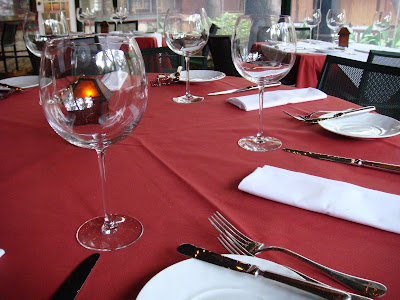 So, when looking for 'real world' examples of how the 'credit crisis' is affecting 'real people' NPR turned to a mailwoman this morning who, naturally enough, knows a lot about her 'clients' and their financial status simply by the color of the envelopes and the magazine subscriptions that they receive.
 This got me to thinking about another economic index, one that is no more scientific, but in many ways, as sophisticated. I do, in fact, think that 'apocryphal' indicators like these have considerable value when trying to make sense of something as complicated as political theory and economic practice, since there is a 'reality' factor missing from stock derivative equations that is required for actual understanding of the marketplace. Greenspan understood this; Bernanke does not.
Of course my indicator is the 'Waiter Index' (WI) and the scale is anything but numeric. As such, it's best illustrated with a restaurant story.
Last Saturday night, we had a group of, shall we say, 'well off' people sitting a one of the prime tables in the restaurant. Oh hell, I'll just say it, they were some fat (literally) cats from Dallas or Houston who were in town for the game and were staying at their second (or third) home in Lakeway. These guys are the ones whose asses are in the fire right now, and the way their semi-blocked hearts are doubtless pounding these days, I am sure they'd have rather been at home drinking beer and eating burgers than dropping a few more dimes at H______.
Nonetheless, they found themselves at table 14 on a Saturday night, facing the ever-difficult dilemma for the rich these days: what wine to choose.
"He's only got a couple of things here that are not on Main street", said fat cat number one to fat cat number two as he passed him the wine list. Standing right beside him, I listened despite being ignored.
"Well," I offered helpfully, introducing myself to the table this time, since he hadn't bothered to look up and/or even acknowledge my presence so far. "I have a lot of wines that are not very well known but I can assure you, they are quite good." I said.
"The Neal Cabernet, for example, isn't a 'Main Street' wine, but I think you'll be impressed with it." I was making eye contact with a woman across the table when the host--I'm being generous--finally looked up at me and warned, with a raised eyebrow and his most indignant-with-the-help posture, "Don't be condescending, now. Would you bet your tip on it?"
First of all, I found it telling that he considered my comment to be condescending, as he clearly intended to corner the market on that commodity all evening, and obviously would brook no insubordination from a servant. Whether or not he realized that his guests could see the irony of his position was immaterial, for this lord of the manor, the important part of the exchange from his perspective is to show that he know how to keep these people in their place. It's a common phenomenon, known quite well to servants in every walk, and it just comes with the territory. We keep our cool and our jobs.
Telling too, was his comment about the tip, since he also clearly regarded his perception of the quality of my service as the determining factor for his largesse.
This too is typical of rich people who have never been taught how to properly interact with servants, especially waiters. They still think, as do most people, to be honest, that they have the right to determine how much I will will make based on how well they perceive my service to have been.
Now, it's doubtful that my host would have allowed his 'clients' (or whatever he may call them) to decide how much they would pay him for his services (and everyone services someone, do not forget) based solely on their perceptions of his effectiveness, or he wouldn't even have been at the table at H______ on a Saturday night.
The host eventually chose a bottle of Jordan Cabernet, a wine right off Main Street. This is likely due to the fact that it cost ten dollars less than the wine I'd recommended, but also I think, more fundamentally, because he was trying his best to associate himself with the more common wine. How ridiculous is that? A safe choice in these uncertain times. Decisions like these are at the heart of the financial crisis. Is it any wonder that this thing is melting down?
Individuals with no more heart and or common sense than the pompous fool at my table are trying to save their sorry asses by saving ten dollars on a bottle of wine and stiffing the waiter to boot.
The WI shows Obama leading by the narrowest of margins.
Thursday, October 9, 2008
On Not Reading the OED
Now I'll admit that reading the Oxford English Dictionary is not something I have on my agenda in the near or even distant future. Nor do I have plans to read the Abridged New American Dictionary or even parts of Roget's Thesaurus this weekend, but I cannot claim to be entirely unsympathetic to Ammon Shea, for I too, share a peculiar fascination with and even, yes, love for words.
I really do love a good word. I really love the fact that each word exists because it does something that no other word can. Even though many words may indeed serve multiple purposes, there is no doubt that each word is crafted to serve meaning itself, and our desire to transfer it from and to one another across time and space. I particularly love words that have layers of meaning or can be used many ways, but that doesn't deter my affection for longer and less used expressions. I love it all.
And yet, I am not a reader. It's not the reading of words that I love so much, but the writing of them. A friend recently told me that they had not time to read all the memoirs of all the people who are writing blogs these days, and I certainly concur. I write, but I do not read. Oh certainly, I read the news, and the news of the Weired most of all, but that doesn't count. I've been fortunately obliged to revisit some classic American poetry of late, but that doesn't mean I've been reading Frost, or Stevens or Eliot so much as I've stumbled on them in my path. Reading ragged letters in the streetlight doesn't make me exactly literate.
But I am, of course, also arrogant enough to believe that I really haven't time for both reading and writing. Simply knowing that I should read more doesn't make it so, nor is it any more likely as I grow older. I'm not pleased with this sort of calcification, and know I have to do something to correct it, sooner rather than later.
However, as a UT employee, I can take advantage of program here called the Staff Educational Benefit. This program allows all UT staff members to take one class per semester free of charge. So, to that end, I've decided that this spring, I will take a literature class that will again force me to read, if not freely, at least for my own benefit. Of course, I could also take a philosophy class or even a physics class. So, the question remains, what to read?
What say you, readers of this journal?
I really do love a good word. I really love the fact that each word exists because it does something that no other word can. Even though many words may indeed serve multiple purposes, there is no doubt that each word is crafted to serve meaning itself, and our desire to transfer it from and to one another across time and space. I particularly love words that have layers of meaning or can be used many ways, but that doesn't deter my affection for longer and less used expressions. I love it all.
And yet, I am not a reader. It's not the reading of words that I love so much, but the writing of them. A friend recently told me that they had not time to read all the memoirs of all the people who are writing blogs these days, and I certainly concur. I write, but I do not read. Oh certainly, I read the news, and the news of the Weired most of all, but that doesn't count. I've been fortunately obliged to revisit some classic American poetry of late, but that doesn't mean I've been reading Frost, or Stevens or Eliot so much as I've stumbled on them in my path. Reading ragged letters in the streetlight doesn't make me exactly literate.
But I am, of course, also arrogant enough to believe that I really haven't time for both reading and writing. Simply knowing that I should read more doesn't make it so, nor is it any more likely as I grow older. I'm not pleased with this sort of calcification, and know I have to do something to correct it, sooner rather than later.
However, as a UT employee, I can take advantage of program here called the Staff Educational Benefit. This program allows all UT staff members to take one class per semester free of charge. So, to that end, I've decided that this spring, I will take a literature class that will again force me to read, if not freely, at least for my own benefit. Of course, I could also take a philosophy class or even a physics class. So, the question remains, what to read?
What say you, readers of this journal?
Wednesday, October 8, 2008
Micro or Macro?
 As the stock market continues to melt down, and the affairs of the 'middle class' seem to be thrown into disarray, I have begun to wonder about what strategy for financial survival is best, and why.
 Since I do not feel personally threatened by the economic troubles of people wealthier and less risk-averse than I am and have been, I cannot say whether or not a change in strategy would have averted the 'crisis' that these people are experiencing, because, fundamentally, it's all a gamble, a big bet, and even knowing that the odds were longer at the time that they 'bought in' to this mess, I don't think they would have bet less or less often. These 'fools' would simply have told themselves exactly what they did: "It looks good to me. It'll be alright."
That's the micro-view.
The macro view, despite having the advantage during bad times like these, doesn't guarantee financial 'success' or 'security' or anything other than the relative safety of the absence of excessive risk. In other words, playing it safe may look good when everyone is losing their shirt, but how often does that happen and for how long? Who really is the 'fool'?
Lynda lived through the Great Depression and, of course, never let me forget it. In a very real way, she had no choice. The experience of living in a world when no one, not even the best and brightest or hardest working had any money convinced her that wealth was but an illusion; groceries mattered more. And so, though a glass darkly, I have for my whole life looked skeptically at wealth and the pursuit of it.
That sounds facile, now, because it also sounds like an excuse for financial failure, or at the least, a failure to cash in on the economic boom of the Clinton years. But it is the truth. I have never had the stomach for much risk, especially after I had a family to support. Sure, I have wasted a lot of money, no doubt, and it might be easier to acknowledge this fact if I had in fact made risky investments that failed, but in fact I simply frittered the hard-earned money away. This is a regret, to be sure, but not a serious one, since we always had food on the table; that grocery index' never found us wanting.
As an example of this practice, we never moved from the little cracker-box we call home for the very reasons I named above. In spite of a rising income, especially in the last seven or eight years, we never felt comfortable with the idea of selling our house and 'trading up' for a larger, more expensive house. In fact, we often drove by new neighborhoods where houses that cost two and three times what ours did stood cheek to jowl on tree-less streets and wondered, "Who is buying these houses? What do they do for a living and how can they afford it?"
Well, we're about to find out. Ironically, it seems likely that the risk we never took may actually pay off in the long run. But was it worth it? Goodness knows, Valery has endured a life harder and a house smaller than she deserved. Who knows, maybe we'll be the ones buying when all the 'For Sale' signs go up.
Not likely, though, as I continue to hold to the macro view.
Monday, October 6, 2008
Pierre's Birthday
 |
| From P's Tree |
Today we buried Pierre, on what would have been his twenty-first birthday. I know, it's odd, backwards, even, being buried not on one's death day, but on the anniversary of one's birth. It is, however, an appropriately symbolic event to honor Pierre, who would have, at the very least, appreciated the irony. He'd also have loved the tree that we planted for him; a tall thin newly emerging Pecan. It has a slight bend in the middle and a twist overall as it reaches up for the open sky.
My hands and back hurt from the labor of the day. We not only planted the tree, but also built a low retaining wall around it in the back yard, defining the space and leveling the yard from the back of the house out. We will plant a garden around the tree and set up a flagstone patio below the wall to place the hammock where Valery can enjoy a view of the greenbelt with the shade of Pierre's tree overhead.
The pain of hard labor is good for me, however. It blocks from my mind the pain of my heart, though on such a day I have no reason to hold back my emotions and did not. We had a couple of good cries, if you can call them that, for the tears come not in torrents or waves, but in pulses of thick feelings, like molten magma forcing its way through the hardened crust. The will of the earth is strong, but the force of liquid rock is stronger. The annealing power of pain is repeated, pounded and folded into the blade of my heart. Each pass through the fire readies me for a new shape, but nothing can prepare me for hurt of the hammer as it strikes again and again.
Even knowing that I will emerge stronger from the experience has no palliative power; little wonder it is, knowing as I do that we all succumb to the transformative force of death. For most of us, death comes but a little at a time. Pierre, in his way, simply took his entire dose at once. Never one to turn from the truth, he has gone to meet it, while I will wait a while longer if I can.
To say that miss him is to understate that truth, so in keeping with my philosophy of taking only what I need and can digest, for now, I will miss him only as much as I can today, and leave the rest for tomorrow.
Pierre, my beautiful and lost child, I love you.
Friday, October 3, 2008
Death is No Excuse
The wages of poetry may be low, but apparently even for the famous, death is no excuse for not paying your bills.
Bad news for poets in these troubling times.
Bad news for poets in these troubling times.
Dreamer
Listening to an interview with Philip Glass this morning on the radio, I heard his voice for the first time. It was very much like my own, oddly, and very reassuring in the nuances of his expressions, but that shouldn't be all that surprising, since that is one of the hallmarks of his music.
I came to the interview late, as Glass was talking about Einstein, one of the inspirations for his work. Specifically, he was talking about a piece called Einstein on the Beach, of which they played a brief clip. I am no fan of Glass; I don't dislike his work, but simply I find it to be too often too repetitive.
This is, of course, a natural and doubtless common reaction to Glass' art because it is also another of the hallmarks of his style. He even wryly referred to this salient trait when asked by the interviewer which bit of Beach would be most appropriate to play, noting that it almost didn't matter, given the length and repetitive style of the piece, which is essentially numbers set to music being sung by a large choir. I hadn't heard it before and was delighted to discover that it was powerful and compelling, though I suppose I shouldn't have been so surprised since this was his intent.
But it wasn't the music that intrigued me so. It was his description of the muse for the piece, a man that he described as both a dreamer and a poet; a rockstar before there was such a thing. In an instant, Glass' music and words made clear to me what I have known instinctively all along.
E=mc2 is a poem.
This simple equation has often been described as beautiful by physicists, for good reason, but until today I had not made the connection that Glass found obvious enough to write a piece of music about. Always late to the party, I nonetheless enjoy myself on arrival. It is the extreme simplicity of the equation that resembles poetry is it's most delightful form. Stripped of unnecessary words, meaning in poetry is made more resonant, and in this case, the removal of extraneous meaning is complete. With no more than five characters, Einstein dreamed an entire world view.
No poet can hope do do more.
I came to the interview late, as Glass was talking about Einstein, one of the inspirations for his work. Specifically, he was talking about a piece called Einstein on the Beach, of which they played a brief clip. I am no fan of Glass; I don't dislike his work, but simply I find it to be too often too repetitive.
This is, of course, a natural and doubtless common reaction to Glass' art because it is also another of the hallmarks of his style. He even wryly referred to this salient trait when asked by the interviewer which bit of Beach would be most appropriate to play, noting that it almost didn't matter, given the length and repetitive style of the piece, which is essentially numbers set to music being sung by a large choir. I hadn't heard it before and was delighted to discover that it was powerful and compelling, though I suppose I shouldn't have been so surprised since this was his intent.
But it wasn't the music that intrigued me so. It was his description of the muse for the piece, a man that he described as both a dreamer and a poet; a rockstar before there was such a thing. In an instant, Glass' music and words made clear to me what I have known instinctively all along.
E=mc2 is a poem.
This simple equation has often been described as beautiful by physicists, for good reason, but until today I had not made the connection that Glass found obvious enough to write a piece of music about. Always late to the party, I nonetheless enjoy myself on arrival. It is the extreme simplicity of the equation that resembles poetry is it's most delightful form. Stripped of unnecessary words, meaning in poetry is made more resonant, and in this case, the removal of extraneous meaning is complete. With no more than five characters, Einstein dreamed an entire world view.
No poet can hope do do more.
Wednesday, October 1, 2008
Inventory
I have never been good with numbers, so it is ironic that one of my key tasks at Hudson's is the monthly inventory. It comes with the territory, of couse. I buy the wine for the restaurant so I have to count it all. It might seem to be disincentive for having an extensive wine list, but the nature of the substance itself precludes that. Every time I discover a new vineyard, variety or blend, I give no thought to the counting this will later require. The list and monthly task simply get longer.
As I thought ahead to the job I have to do this afternoon, I thought back to the first time I took inventory, and it wasn't at Hudson's. It was years ago, with my father Bill in the bookstore that he and my mother had purchased in Abilene, Texas, the year after I was born.
Growing up in a bookstore was more than interesting for a child of my nature. It was formative in a wonderful way. I must have inherited my love for books from my parents, a love I still have today. Considering that I have never willing discarded a book I've owned, this habit is more of a function (or disfunction) of my quirky personality and tendency toward collecting things than it is a love for reading, but at least I have never had to count them all.
Math does not come naturally to me, but inventory thankfully involves only the simplest of math, and I am the complete master of stroke counting, so it isn't as onerous as I make it out to be, merely time consuming. Of course, it would be considerably less time consuming if there were two of us working on the task, one counting and the other recording and adding it up, which is the way that Bill and I worked together. My job was the counting part, and I can recall scrambling around in the bottom shelves, looking in and behind other books to come up with the number Bill was waiting to hear. I believed it was important work, and I took it seriously, but enjoyed it mostly because I got to work with my Dad.
This was not the only job I got to help him with. I can also remember learning to count money with Bill at the register in the evenings, and he always took me to the bank with him for the day's deposits. We'd get in that '57 Chevy Malibu and roll over to the big Bank downtown, only about ten blocks away.
With its marble floors, tall dark wooden tables, pens on chains and brass fittings around the big steel gate that led to the vault, the Bank was a most impressive place. Bill would introduce me as his assistant, which always sounded very important, and make sure that I got one of the cherry lollipops in the jar up on the counter. Eventually, the bank opened a drive-thru, which meant that I no longer got to see the blind cigar and candy vendor in the lobby, but I still got the lollipop.
What I remember most about the experiences with Bill were how tender and gentle he was. I always held his hand, and he frequently lifted me up to get a better view, even when I must have been far too old for that. All this changed when I went to school, but for a few glorious years, I was his right-hand man.
As I thought ahead to the job I have to do this afternoon, I thought back to the first time I took inventory, and it wasn't at Hudson's. It was years ago, with my father Bill in the bookstore that he and my mother had purchased in Abilene, Texas, the year after I was born.
Growing up in a bookstore was more than interesting for a child of my nature. It was formative in a wonderful way. I must have inherited my love for books from my parents, a love I still have today. Considering that I have never willing discarded a book I've owned, this habit is more of a function (or disfunction) of my quirky personality and tendency toward collecting things than it is a love for reading, but at least I have never had to count them all.
Math does not come naturally to me, but inventory thankfully involves only the simplest of math, and I am the complete master of stroke counting, so it isn't as onerous as I make it out to be, merely time consuming. Of course, it would be considerably less time consuming if there were two of us working on the task, one counting and the other recording and adding it up, which is the way that Bill and I worked together. My job was the counting part, and I can recall scrambling around in the bottom shelves, looking in and behind other books to come up with the number Bill was waiting to hear. I believed it was important work, and I took it seriously, but enjoyed it mostly because I got to work with my Dad.
This was not the only job I got to help him with. I can also remember learning to count money with Bill at the register in the evenings, and he always took me to the bank with him for the day's deposits. We'd get in that '57 Chevy Malibu and roll over to the big Bank downtown, only about ten blocks away.
With its marble floors, tall dark wooden tables, pens on chains and brass fittings around the big steel gate that led to the vault, the Bank was a most impressive place. Bill would introduce me as his assistant, which always sounded very important, and make sure that I got one of the cherry lollipops in the jar up on the counter. Eventually, the bank opened a drive-thru, which meant that I no longer got to see the blind cigar and candy vendor in the lobby, but I still got the lollipop.
What I remember most about the experiences with Bill were how tender and gentle he was. I always held his hand, and he frequently lifted me up to get a better view, even when I must have been far too old for that. All this changed when I went to school, but for a few glorious years, I was his right-hand man.
Tuesday, September 30, 2008
Pray
God will not be impressed with the morals of this nation when accounting for the lives it has chosen to abort.
Pray - pray fervently and long.
Why?
Because abortion is wrong
G.
This bit of bullshit needs some refutation. The person who wrote those words calls himself religious (I'll call him G.), but the morality of his life is in doubt no more or less than those he seeks to condemn.
And have no doubt. These are the words of condemnation. These are the sort of words that have given religion the bad name it deserves. G.'s appeal to pray is not an attempt to reconcile with those who might have doubts about their actions and are thus seeking spiritual and religious advice. No, in this case the call to prayer is a threat. The subtext says quite clearly that the consequences will be unfavorable, and, lest you have any doubt, the writer reinforces his point by being blunt and speaking for God directly.
I can only imagine what God will do to all those fools who have chosen to speak on His behalf while here on earth. If it turns out that He is the all-knowing guiding hand behind all of our actions and inactions, well, He is likely to be upset with the many conflicting interpretations of His Word. After all, I don't think He is going to take kindly to all those people who got it wrong.
I mean, let's say it turns out that God actually had a plan for aborting all those babies, what will He have to say to all those righteous zealots who tried to subvert His Plan? Why is it that God's Plan includes only those things deemed right and proper by the supposedly righteous religious interpreters of His Word and seeks to exclude all that is wrong and bad in the world? Why is it impossible that God's plan includes abortion? And why would a person, any person, be asked to step in for God and condemn his fellow creatures for their missteps in God's name? How arrogant.
Isn't it simple arrogance to assume that one can know God and/or His will? Many say that they can divine His intent through the Bible. Yet we know that the Bible is fraught with contradictions that are dismissed as anachronistic when they don't suit our needs (like the righteousness of stoning a woman who has committed adultery, for example) or are dismissed as ambiguous when they support the ideas of others (such as tolerance for others, like homosexuals, who somehow deviate from the 'norm').
Well, I've decided that if G. can talk with God and know what He will and will not 'be impressed with', I can too. So, I called Him up and asked Him if what G. said was true. Now, I can't quote Him here because He asked me not to, and, out of respect for His Word, I won't. I have to tell you though, given what He can do to me if I don't obey, I decided to honor His request. In our brief conversation (He was pretty busy this morning, what with the continuing U.S. financial crisis--apparently G.W. needs some personal guidance today), He was pretty clear about His intent though.
If you ask me, then, I believe that God will not be very impressed with those who have lived off the hard work of others, especially those who have not toiled in the service of Man but who have wasted their time on this earth by judging and condemning their fellow humans in the name of God. Collecting money to travel to the South Pacific to proselytize the 'natives' is a brazen example of how God's name is exploited by the pseudo-religious for personal gain.
Hell, I'd love to go to Tahiti on God's dime, wouldn't you? Lest you think I am inventing this, recall that last year, G. sent letters soliciting money to members of his extended family without regard for how they might feel about such blatant begging in the name of God. Whether or not he raised enough money to take his family on vacation is unknown to me. Likely he raised enough to get only halfway, then said, "The heck with it, let's just go to Canada".
Curiously, I agree with G. when urged to pray, for this may be the only way to get God to discipline arrogant idiots like G. who claim to speak for Him. So I will pray.
I fervently pray that those who have corrupted the mind of Man with empty promises of salvation shall find themselves at the mercy of their own creation.
Pray - pray fervently and long.
Why?
Because abortion is wrong
G.
This bit of bullshit needs some refutation. The person who wrote those words calls himself religious (I'll call him G.), but the morality of his life is in doubt no more or less than those he seeks to condemn.
And have no doubt. These are the words of condemnation. These are the sort of words that have given religion the bad name it deserves. G.'s appeal to pray is not an attempt to reconcile with those who might have doubts about their actions and are thus seeking spiritual and religious advice. No, in this case the call to prayer is a threat. The subtext says quite clearly that the consequences will be unfavorable, and, lest you have any doubt, the writer reinforces his point by being blunt and speaking for God directly.
I can only imagine what God will do to all those fools who have chosen to speak on His behalf while here on earth. If it turns out that He is the all-knowing guiding hand behind all of our actions and inactions, well, He is likely to be upset with the many conflicting interpretations of His Word. After all, I don't think He is going to take kindly to all those people who got it wrong.
I mean, let's say it turns out that God actually had a plan for aborting all those babies, what will He have to say to all those righteous zealots who tried to subvert His Plan? Why is it that God's Plan includes only those things deemed right and proper by the supposedly righteous religious interpreters of His Word and seeks to exclude all that is wrong and bad in the world? Why is it impossible that God's plan includes abortion? And why would a person, any person, be asked to step in for God and condemn his fellow creatures for their missteps in God's name? How arrogant.
Isn't it simple arrogance to assume that one can know God and/or His will? Many say that they can divine His intent through the Bible. Yet we know that the Bible is fraught with contradictions that are dismissed as anachronistic when they don't suit our needs (like the righteousness of stoning a woman who has committed adultery, for example) or are dismissed as ambiguous when they support the ideas of others (such as tolerance for others, like homosexuals, who somehow deviate from the 'norm').
Well, I've decided that if G. can talk with God and know what He will and will not 'be impressed with', I can too. So, I called Him up and asked Him if what G. said was true. Now, I can't quote Him here because He asked me not to, and, out of respect for His Word, I won't. I have to tell you though, given what He can do to me if I don't obey, I decided to honor His request. In our brief conversation (He was pretty busy this morning, what with the continuing U.S. financial crisis--apparently G.W. needs some personal guidance today), He was pretty clear about His intent though.
If you ask me, then, I believe that God will not be very impressed with those who have lived off the hard work of others, especially those who have not toiled in the service of Man but who have wasted their time on this earth by judging and condemning their fellow humans in the name of God. Collecting money to travel to the South Pacific to proselytize the 'natives' is a brazen example of how God's name is exploited by the pseudo-religious for personal gain.
Hell, I'd love to go to Tahiti on God's dime, wouldn't you? Lest you think I am inventing this, recall that last year, G. sent letters soliciting money to members of his extended family without regard for how they might feel about such blatant begging in the name of God. Whether or not he raised enough money to take his family on vacation is unknown to me. Likely he raised enough to get only halfway, then said, "The heck with it, let's just go to Canada".
Curiously, I agree with G. when urged to pray, for this may be the only way to get God to discipline arrogant idiots like G. who claim to speak for Him. So I will pray.
I fervently pray that those who have corrupted the mind of Man with empty promises of salvation shall find themselves at the mercy of their own creation.
Monday, September 29, 2008
Thirteen Things for My Daughter
I don't know exactly when I came up with these bits of advice for Maddie, but I wrote them before she left for Portland. I found them in a journal today and felt that they were worth posting.
1. Tell the truth. Always and especially to yourself.
2. Don't wait to be told. Pay attention and do what needs to be done.
3. Be your best friend. No one else can be.
4. Be your toughest critic. No one else will bother.
5. Laugh at yourself. Don't take yourself too seriously.
6. Cry when you have to. There's no shame in tears.
7. Don't gossip. Unless you want to hear about yourself.
8. Be proud of your body. It's the only one you'll get.
9. Say "Yes"! You'll figure it out.
10. Ask. The worst anyone can say is, "No".
11. When things don't look like they are going to work out, change direction. Your life has a rudder; it's called your mind.
12. There is no such thing as failure. It is only a change in direction.
13. There is no such thing as success. It is only a pause on the way.
1. Tell the truth. Always and especially to yourself.
2. Don't wait to be told. Pay attention and do what needs to be done.
3. Be your best friend. No one else can be.
4. Be your toughest critic. No one else will bother.
5. Laugh at yourself. Don't take yourself too seriously.
6. Cry when you have to. There's no shame in tears.
7. Don't gossip. Unless you want to hear about yourself.
8. Be proud of your body. It's the only one you'll get.
9. Say "Yes"! You'll figure it out.
10. Ask. The worst anyone can say is, "No".
11. When things don't look like they are going to work out, change direction. Your life has a rudder; it's called your mind.
12. There is no such thing as failure. It is only a change in direction.
13. There is no such thing as success. It is only a pause on the way.
Prufrock
One great pleasure that has come my way recently has been to help a young friend of Maddie study poetry.
As a college freshman, she is taking a basic literature class, Intro to American Literature Since 1865. This includes the poetry of Whitman, Frost, Stevens, Eliot and Cummings. I took the same class in 1976, read the same poems and, just like Tenisha, didn't understand them at all. It was as if they were writing in a foreign language. Dr. Pelen, my professor, got it, but I did not.
But somehow those poems stuck with me. Reading Stevens' Sunday Morning made me choke up as I discovered that it was about me, 30 years later. And, at this point in my life, I even have some sympathy for Prufrock, whom I never thought I'd resemble. Yet now, the metaphors Eliot called upon appear to be not mere empty warnings to a facile youth, but serve as markers for what turns out to be a questionable life.
It is comforting, I suppose, to know that I have been a part of a long tradition, but because it is a history of failed ambitions and empty promises, it's a bittersweet flavor that lingers. I remind myself that it's just another poem and I am just another man.
Of course, at this bit of humility too, I fail, for I am still convinced that I am a poet, and that these great works that I ignored in my youth are but signs to guide me; passions on the path to inspiration.
I am not absent self-doubt, but I will press on as if I had no choice, which is, of course, the way it is.
As a college freshman, she is taking a basic literature class, Intro to American Literature Since 1865. This includes the poetry of Whitman, Frost, Stevens, Eliot and Cummings. I took the same class in 1976, read the same poems and, just like Tenisha, didn't understand them at all. It was as if they were writing in a foreign language. Dr. Pelen, my professor, got it, but I did not.
But somehow those poems stuck with me. Reading Stevens' Sunday Morning made me choke up as I discovered that it was about me, 30 years later. And, at this point in my life, I even have some sympathy for Prufrock, whom I never thought I'd resemble. Yet now, the metaphors Eliot called upon appear to be not mere empty warnings to a facile youth, but serve as markers for what turns out to be a questionable life.
It is comforting, I suppose, to know that I have been a part of a long tradition, but because it is a history of failed ambitions and empty promises, it's a bittersweet flavor that lingers. I remind myself that it's just another poem and I am just another man.
Of course, at this bit of humility too, I fail, for I am still convinced that I am a poet, and that these great works that I ignored in my youth are but signs to guide me; passions on the path to inspiration.
I am not absent self-doubt, but I will press on as if I had no choice, which is, of course, the way it is.
Saturday, September 27, 2008
Fifty for Dinner, Please
It was Tuesday night. Ordinarily I am not in the restaurant on a Tuesday, but this night I was preparing for our first wine dinner of the season, so I was in one of the dining rooms near the front door, setting tables, folding napkins when I heard the exchange.
"Hi folks" said Sara, in her best and brightest hostess voice to the well dressed grey haired man who just walked in. "Have you got a reservation?"
I couldn't see his face, but I could hear his voice. "Oh yes," he said, putting away his Blackberry to talk with Sara face-to-face. "It's under Johnson" he said confidently, "Or possibly St. Ignatius Health Care". [Note, names have been changed]
I could hear Sara's silence as she searched for the name on the computer. The next question, I knew, came because in fact she had not fund either name in her book, "And how many people are in your party?"
We ask this because often people will arrive without knowing the name of their actual host. Doctors, for example, frequently attend functions held by drug companies and though they know the restaurant that they are supposed to go to, they have no idea what the name of the drug company rep--usually a twenty-something whom they've never actually met--nor the name of the 'sponsoring' doctor for the event.
"Um, well," he said slowly, as is figuring in his head, "I guess there's about fifty of us. You'll have to ask Brenda for the exact count, since she arranged all of this. In fact, she'll be here, along with the rest of them, in just a minute."
His optimism was premature. In fact, we had no idea that this group was coming. Now, to be fair, Sara cannot conceal this obvious fact from the customer, but neither can she appear rattled or unprepared to serve the horde about to descend upon us. To her credit as a tried and true professional, she did neither. She quickly discovers that this group has actually been scheduled for the next night, a Wednesday.
This had some good consequences, for it meant that we were not totally unprepared, just not ready on this night. The chef already had the food and most of it was already prepped. Considering that the menu involved passed hors d'oeurves and four courses, he had a lot to do in a very short time, but to his credit, he pulled it off beautifully.
As Robert marshaled his troops in the kitchen to prepare for the approaching wave of work, out front, we completely re-organized and re-set the entire restaurant in about ten minutes. This is a situation well know to those of us in the business, so to speak. We call it 'all hands on deck' and it means that everyone has to work on the problem at hand, now.
We had several long tables set up in the back dining rooms that would have accommodated them, but on her arrival, not only did the coordinator deny responsibility for the mix-up by claiming she had a 'string of emails' to show that this was in fact the day, but she also insisted, indignantly, that they had been promised the two front rooms.
A confrontation at this point would serve no one, so Sara judiciously said that we wouldn't worry about the 'blame game' for now, but just do what we had to do to pull it off. "Give us ten minutes" she said, and that's all we needed.
In ten minutes, like ants rebuilding their kicked over mound, we completely reset the two front rooms, moving, in the process, two couples that had already been seated in those rooms at our expense (meaning, we bought their meals). We also broke down the large tables in the back into a lot of smaller tables so we could seat the rest of the scheduled guests that evening.
Now, while Robert had all his food in house, I was actually short on the red wine. This was because the CEO had only just selected the wines the day before in a personal phone call to me, and having been ordered so late, it wasn't supposed to come in till the next day. Now, of course, I have some good wines in quantity in reserve, but it wasn't the wine he'd chosen. When he saw this after being seated, he called me over.
"I see you are not pouring the wine we agreed on," he said sternly.
"Um yes sir," I acknowledged reluctantly. I hate it when this happens, because all I can do is apologize and hope they'll understand because of the mix-up. I was clearly hoping for this when I said, "The wine you ordered didn't come in today. You understand, considering the mix-up"
"No," he said, "What mix-up?"
Now at this point I realized that no one had told him about the fact that they were in the restaurant on what, from our perspective was the wrong day. And, why should he be bothered? It was in fact a tribute to the way we were pulling it off that he didn't realize that it was the wrong day. It was, of course, the right day for him, and there was no way I could explain this in the few seconds I was being alloted.
"Oh," I said, "There was a delay in getting the wines out of Houston. This is a very good wine, however," I said, hoping to divert his attention to the wine itself. "I think it's even better than the wine we had hoped to serve."
"So it's what we were drinking outside?"
"Yes" I lied.
"Then it's great!" he said, and turned away.
Whew. Boy was I lucky. Brenda's ass was covered at my expense.
The rest of the party went off without a problem. The waiters all had to take extra tables, and even I had to wait on two tables in addition to the wine dinner. Some of the busboys, who have never seem me with an apron on, didn't know that I knew how, or that I was as good as I am, so it was fun to see their faces as I moved in and around my tables, serving and clearing as if it were second nature to me. Oh wait, it is.
Now, the punchline to this story comes the next day. Brenda sent our catering coordinator an apology email...of sorts. "I guess I screwed up," were her exact words, but nowhere in the subsequent text did the words "I'm sorry" appear. While she did give us credit for pulling it off, this woman had--still has--absolutely no appreciation for what a disruption her lack of planning had put upon us that evening.
Ok, Brenda did in fact send Sara a bouquet of flowers, but this is simply another gross misinterpretation of how the restaurant actually works. Sara did a great job, no doubt. But in fact, it was the kitchen that pulled off the miracle that Brenda could not even begin to comprehend.
This is not unexpected, really. After all, she has no way to compare it with her own working life. I doubt seriously if she could manage to accommodate such a serious disruption in her daily work flow, but that isn't even the point. It's about taking responsibility for one's actions. Oh and by the way, the 'string of emails' to which she referred as proof of her innocence did actually exist, but in fact, they proved her guilt. In one particularly detailed email sent by her just the day before, she acknowledged that we would see her "on Wednesday night".
I have promised not to whine here, and I hope this doesn't come off that way. After all, in this business, we are here to serve and work hard, so it isn't the unnecessary humility or the extra work that prompts these words. I am proud of what we were able to do. It's moments like these, honestly, that make the job more interesting. What brings me to comment, I suppose, is the complete absence of appreciation for the professional lives of others, especially, may I say carefully, in the 'healthcare' field.
I think that it doesn't take much to value adequately the work that others do for you, even it it's a simply thank you for services rendered, or an apology when it is due. The fact that Brenda probably never told her boss about her little 'screw-up' has double consequences in that he was pleased with the dinner yet he has no idea what we had to go through to make it happen. That, however, is the nature of the business, I guess.
If you do your job well, it looks effortless.
"Hi folks" said Sara, in her best and brightest hostess voice to the well dressed grey haired man who just walked in. "Have you got a reservation?"
I couldn't see his face, but I could hear his voice. "Oh yes," he said, putting away his Blackberry to talk with Sara face-to-face. "It's under Johnson" he said confidently, "Or possibly St. Ignatius Health Care". [Note, names have been changed]
I could hear Sara's silence as she searched for the name on the computer. The next question, I knew, came because in fact she had not fund either name in her book, "And how many people are in your party?"
We ask this because often people will arrive without knowing the name of their actual host. Doctors, for example, frequently attend functions held by drug companies and though they know the restaurant that they are supposed to go to, they have no idea what the name of the drug company rep--usually a twenty-something whom they've never actually met--nor the name of the 'sponsoring' doctor for the event.
"Um, well," he said slowly, as is figuring in his head, "I guess there's about fifty of us. You'll have to ask Brenda for the exact count, since she arranged all of this. In fact, she'll be here, along with the rest of them, in just a minute."
His optimism was premature. In fact, we had no idea that this group was coming. Now, to be fair, Sara cannot conceal this obvious fact from the customer, but neither can she appear rattled or unprepared to serve the horde about to descend upon us. To her credit as a tried and true professional, she did neither. She quickly discovers that this group has actually been scheduled for the next night, a Wednesday.
This had some good consequences, for it meant that we were not totally unprepared, just not ready on this night. The chef already had the food and most of it was already prepped. Considering that the menu involved passed hors d'oeurves and four courses, he had a lot to do in a very short time, but to his credit, he pulled it off beautifully.
As Robert marshaled his troops in the kitchen to prepare for the approaching wave of work, out front, we completely re-organized and re-set the entire restaurant in about ten minutes. This is a situation well know to those of us in the business, so to speak. We call it 'all hands on deck' and it means that everyone has to work on the problem at hand, now.
We had several long tables set up in the back dining rooms that would have accommodated them, but on her arrival, not only did the coordinator deny responsibility for the mix-up by claiming she had a 'string of emails' to show that this was in fact the day, but she also insisted, indignantly, that they had been promised the two front rooms.
A confrontation at this point would serve no one, so Sara judiciously said that we wouldn't worry about the 'blame game' for now, but just do what we had to do to pull it off. "Give us ten minutes" she said, and that's all we needed.
In ten minutes, like ants rebuilding their kicked over mound, we completely reset the two front rooms, moving, in the process, two couples that had already been seated in those rooms at our expense (meaning, we bought their meals). We also broke down the large tables in the back into a lot of smaller tables so we could seat the rest of the scheduled guests that evening.
Now, while Robert had all his food in house, I was actually short on the red wine. This was because the CEO had only just selected the wines the day before in a personal phone call to me, and having been ordered so late, it wasn't supposed to come in till the next day. Now, of course, I have some good wines in quantity in reserve, but it wasn't the wine he'd chosen. When he saw this after being seated, he called me over.
"I see you are not pouring the wine we agreed on," he said sternly.
"Um yes sir," I acknowledged reluctantly. I hate it when this happens, because all I can do is apologize and hope they'll understand because of the mix-up. I was clearly hoping for this when I said, "The wine you ordered didn't come in today. You understand, considering the mix-up"
"No," he said, "What mix-up?"
Now at this point I realized that no one had told him about the fact that they were in the restaurant on what, from our perspective was the wrong day. And, why should he be bothered? It was in fact a tribute to the way we were pulling it off that he didn't realize that it was the wrong day. It was, of course, the right day for him, and there was no way I could explain this in the few seconds I was being alloted.
"Oh," I said, "There was a delay in getting the wines out of Houston. This is a very good wine, however," I said, hoping to divert his attention to the wine itself. "I think it's even better than the wine we had hoped to serve."
"So it's what we were drinking outside?"
"Yes" I lied.
"Then it's great!" he said, and turned away.
Whew. Boy was I lucky. Brenda's ass was covered at my expense.
The rest of the party went off without a problem. The waiters all had to take extra tables, and even I had to wait on two tables in addition to the wine dinner. Some of the busboys, who have never seem me with an apron on, didn't know that I knew how, or that I was as good as I am, so it was fun to see their faces as I moved in and around my tables, serving and clearing as if it were second nature to me. Oh wait, it is.
Now, the punchline to this story comes the next day. Brenda sent our catering coordinator an apology email...of sorts. "I guess I screwed up," were her exact words, but nowhere in the subsequent text did the words "I'm sorry" appear. While she did give us credit for pulling it off, this woman had--still has--absolutely no appreciation for what a disruption her lack of planning had put upon us that evening.
Ok, Brenda did in fact send Sara a bouquet of flowers, but this is simply another gross misinterpretation of how the restaurant actually works. Sara did a great job, no doubt. But in fact, it was the kitchen that pulled off the miracle that Brenda could not even begin to comprehend.
This is not unexpected, really. After all, she has no way to compare it with her own working life. I doubt seriously if she could manage to accommodate such a serious disruption in her daily work flow, but that isn't even the point. It's about taking responsibility for one's actions. Oh and by the way, the 'string of emails' to which she referred as proof of her innocence did actually exist, but in fact, they proved her guilt. In one particularly detailed email sent by her just the day before, she acknowledged that we would see her "on Wednesday night".
I have promised not to whine here, and I hope this doesn't come off that way. After all, in this business, we are here to serve and work hard, so it isn't the unnecessary humility or the extra work that prompts these words. I am proud of what we were able to do. It's moments like these, honestly, that make the job more interesting. What brings me to comment, I suppose, is the complete absence of appreciation for the professional lives of others, especially, may I say carefully, in the 'healthcare' field.
I think that it doesn't take much to value adequately the work that others do for you, even it it's a simply thank you for services rendered, or an apology when it is due. The fact that Brenda probably never told her boss about her little 'screw-up' has double consequences in that he was pleased with the dinner yet he has no idea what we had to go through to make it happen. That, however, is the nature of the business, I guess.
If you do your job well, it looks effortless.
Michigan Summer 2008 - Remix
Alex pointed out that the last version of this vid, Michigan Summer 2008, needed music, and she was right. It also needed to be shorter, so I had the brilliant idea to use some music by Alexandra to pull it all together.
I think you'll like the result, especially because the tune--'Lift me Up'--is so catchy! Granted, I've listened to it a lot lately, but I just can't get that 'hook' out of my head!
Erm, Alex, I used the song without permission, but I gave you props at the end! ;-)
I think you'll like the result, especially because the tune--'Lift me Up'--is so catchy! Granted, I've listened to it a lot lately, but I just can't get that 'hook' out of my head!
Erm, Alex, I used the song without permission, but I gave you props at the end! ;-)
Wednesday, September 24, 2008
Double Down
It has been my practice, until now, to avoid writing about politics because the subject is so volatile and the effect of writing about it so negligible that it made no sense to waste even a moment or a keystroke on it.
But $700 Billion dollars?
Common sense tells you that the treasury secretary's generous offer to bail out a few bloated investment firms is low, so the final total is going to be well over a trillion dollars. So, to paraphrase Sen. Dirsken's famous quote, 'we are talking about real money' and it's got me good and mad.
I am mad because I have worked two jobs for my entire working life. I've paid my bills. My mortgage isn't in jeapordy because I paid it this month. And I paid it last month. Oh, and I have enough to pay it next month, too. How, you ask? How is it even possible, in these troubled times, that I have not managed to sign a mortgage I can't pay?
It's this damn double negative, the Bush double-speak that has it all backward.
Bankruptcy is not prosperity. Five millions dollars is not middle class.
War is not peace.
Let's get it straight. The reason I am not worried about losing my house today is because I signed a mortgage that I knew I could pay. It just took a bit of planning.
Lack of planning. This is, quite simply, what has happened to all these people who are unable or simply unwilling to pay their mortgage payments today. They made no plans that included a downturn in their income or the economy at large. In their lifetimes, thanks in part to Bill Clinton, they have only known prosperity. People were being paid large sums of money for invisible, and, it turns out, untappable 'human resources'.
For example, just a couple of years ago, fresh out of an Ivy League college with a B.S. in engineering, a young graduate could expect to start as a Vice-President of an investment firm for no less than a six-figure salary. The fact that the investment firm might have overvalued their talent never occurred to them. No, it seems that the financial folly of such an arrangement was not obvious to anyone who was not already perplexed about this situation.
Why? The backwardness of the logic was only confounded by double-think. What seemed the investment bankers to be evidence of good fortune and a rising economy was in reality proof of poor judgment and a harbinger of failure based on hubris and greed
Right now, though, I have no sympathy for the many overvalued portfolio managers, investment bankers and brokers and fee-charging middlemen who took all that cheap cash and thought they could somehow launder it in the form of expensive lifestyles based on sheer consumerism. Why should I pay for their lack of common sense, for their failure to plan?
A colleague of mine once had on her desk a small sign that read: 'A failure to plan on your part does not constitute a crisis on my part.'
Even if it doesn't cost me anything directly--which I know not to be true--it is the violation of the principle of moderation that I have held as central to my character my entire adult life that makes me so angry about this today. I say: Let 'em fall, let 'em fail. I'm ready for tough times. My house is in order.
But $700 Billion dollars?
Common sense tells you that the treasury secretary's generous offer to bail out a few bloated investment firms is low, so the final total is going to be well over a trillion dollars. So, to paraphrase Sen. Dirsken's famous quote, 'we are talking about real money' and it's got me good and mad.
I am mad because I have worked two jobs for my entire working life. I've paid my bills. My mortgage isn't in jeapordy because I paid it this month. And I paid it last month. Oh, and I have enough to pay it next month, too. How, you ask? How is it even possible, in these troubled times, that I have not managed to sign a mortgage I can't pay?
It's this damn double negative, the Bush double-speak that has it all backward.
Bankruptcy is not prosperity. Five millions dollars is not middle class.
War is not peace.
Let's get it straight. The reason I am not worried about losing my house today is because I signed a mortgage that I knew I could pay. It just took a bit of planning.
Lack of planning. This is, quite simply, what has happened to all these people who are unable or simply unwilling to pay their mortgage payments today. They made no plans that included a downturn in their income or the economy at large. In their lifetimes, thanks in part to Bill Clinton, they have only known prosperity. People were being paid large sums of money for invisible, and, it turns out, untappable 'human resources'.
For example, just a couple of years ago, fresh out of an Ivy League college with a B.S. in engineering, a young graduate could expect to start as a Vice-President of an investment firm for no less than a six-figure salary. The fact that the investment firm might have overvalued their talent never occurred to them. No, it seems that the financial folly of such an arrangement was not obvious to anyone who was not already perplexed about this situation.
Why? The backwardness of the logic was only confounded by double-think. What seemed the investment bankers to be evidence of good fortune and a rising economy was in reality proof of poor judgment and a harbinger of failure based on hubris and greed
Right now, though, I have no sympathy for the many overvalued portfolio managers, investment bankers and brokers and fee-charging middlemen who took all that cheap cash and thought they could somehow launder it in the form of expensive lifestyles based on sheer consumerism. Why should I pay for their lack of common sense, for their failure to plan?
A colleague of mine once had on her desk a small sign that read: 'A failure to plan on your part does not constitute a crisis on my part.'
Even if it doesn't cost me anything directly--which I know not to be true--it is the violation of the principle of moderation that I have held as central to my character my entire adult life that makes me so angry about this today. I say: Let 'em fall, let 'em fail. I'm ready for tough times. My house is in order.
Saturday, September 20, 2008
Austin Farmer's Market
 Valery and I went to the Farmer's Market this morning.
 It's like the one in Holland, only hotter. Not so many flowers and not so much produce, but there are lots of booths with fresh made baked goods, teas, sauces and even pizzas.

Being in Austin, there is, of course, live music, and lots of dogs! Valery goes every week, but this was my first trip. I took my camera and made a little slideshow video out of a few of them. This is also a test of an embedded video from my Picassa Web Albums, so there is no option to play it in the blog. Clicking takes you to my web albums, and the playback is less than optimal. O well. More testing.
Thursday, September 18, 2008
Cojones
 Well, I guess there was some doubt as to the, shall we say 'manliness' of the UT Tower, so the powers that be (and that may include the actual Powers, as in Bill) have decided to adorn it with an proportionally sized set of, well, balls.
This is actually a sculpture, on loan to UT from the Metropolitan Museum in New York, as part of a campus-wide public art project. The thought is, apparently, that the Met has so much stuff that they cannot display, they've turned to partnerships with public universities like UT to provide a venue for it.
On paper, this sounds like a good idea, but in practice, I have to ask, "What were you thinking?" Perhaps, in this era of post-modern deconstructionism, the panel choosing the sculptures and their locations have overlooked some basic observational tools like iconographic interpretation.
Of course, it's a joke. It's not an expression of ignorance, but a deliberate statement about the role of art--specifically sculpture--on our campus. While it certainly is a funny visual gag, and while the sculpture in this context has some amusing subtexts (like the pennies glued to the balls), it is also an overwhelmingly obvious symbol of the elitist 'old southern' mentality that the University has become infamous for.
Seriously, in an era when it takes ten years to erect a statue of a national hero like Martin Luther King or Cesar Chavez, and the statues of great Civil War heroes cannot seem to be moved to less prominent places on campus, it seems fittingly ironic to place a sculpture like this in such an appropriate position.
But then, after all, "We're Texas"!
Wednesday, September 17, 2008
Self Indulgence
One of the things I struggle most with in my life is my tendency to self indulgence. Especially as I get older, the issue seems to have more impact on my day-to-day life than ever before.
Interestingly, one of the things I found most difficult to accept about my father was my perception of his excessive self-indulgence. As I grew up, especially under the parsimonious influence of Lynda, whose depression experiences shaped every purchase decision she ever made, I felt that Bill was not only not pulling his weight by supporting the family (ie, me), but that he was actively diminishing our resources by failing to restrict his spending. He was always buying something. Over the years, he bought cars, clothes, jewelery, cameras, film, photographic equipment and supplies. He loved new shoes and had more than a dozen pairs. Pens, too, he collected, and watches, clocks and little boxes. I take after him in this way, of course, with my own little collections of useless but pretty things.
I also take after him, it seems, in my inability to limit my acquisitive desires, and this at a time when I really seriously ought to be worried about my finances. However, now that I am older and have had a taste of the intemperance of of life itself, I am less inclined to be judgmental about Bill's spending habits and more inclined to be self-indulgent of the same. As with all thought re-alignments, I am tempted to think that this is the natural course of things, but another part of me wonders if this is, in itself another form of self-indulgence?
I do in fact realize that at this point in life, money is not the object but the means. There is much I want to do, and time will not replenish itself, so it's to be spent as wisely as possible, while money can be replaced, and no amount of self-denial will trade one for the other.
Interestingly, one of the things I found most difficult to accept about my father was my perception of his excessive self-indulgence. As I grew up, especially under the parsimonious influence of Lynda, whose depression experiences shaped every purchase decision she ever made, I felt that Bill was not only not pulling his weight by supporting the family (ie, me), but that he was actively diminishing our resources by failing to restrict his spending. He was always buying something. Over the years, he bought cars, clothes, jewelery, cameras, film, photographic equipment and supplies. He loved new shoes and had more than a dozen pairs. Pens, too, he collected, and watches, clocks and little boxes. I take after him in this way, of course, with my own little collections of useless but pretty things.
I also take after him, it seems, in my inability to limit my acquisitive desires, and this at a time when I really seriously ought to be worried about my finances. However, now that I am older and have had a taste of the intemperance of of life itself, I am less inclined to be judgmental about Bill's spending habits and more inclined to be self-indulgent of the same. As with all thought re-alignments, I am tempted to think that this is the natural course of things, but another part of me wonders if this is, in itself another form of self-indulgence?
I do in fact realize that at this point in life, money is not the object but the means. There is much I want to do, and time will not replenish itself, so it's to be spent as wisely as possible, while money can be replaced, and no amount of self-denial will trade one for the other.
Saturday, September 13, 2008
Cancer College
Although I have been back in College now for more than two years, it was not until my cousin Diane gave to this experience the power of metaphor than I am even able to write about it.
But Diane is a cancer survivor, and has taken the much more advanced classes, so to speak. Her wisdom does not come from here but rather, is brought to it. As a mere witness, I have been struggling with myself to even admit that the disease is here and now and a part of my life and far too many of those I love.
But it is, most certainly. Besides Diane, my Mother-in-law, Billie is afflicted with cancer, as is my long-time friend and mentor, Francesca. Of course, Lynda died of the same, so you'd think I'd be past the denial stage by now, wouldn't you? You think that Lynda, with her legendary strength of will and determination to live life gracefully, would have made peace with it in her many advanced seminars prior to her death. It's what I used to think.
Now, what I do know is that these strong and beautiful women--who are not in denial because the have no such luxury--are showing me the way to deal with cancer with grace and dignity. They do not hesitate to talk about it, though I know that they are weary to do so. These wonderful individuals have the ability to uplift those of us who would selfishly decide to be depressed because we are unable to act. In other words, me.
Or so I thought. While I struggle with what to say to them, they have no trouble telling me what I must hear. It is not death, they say, nor even a death sentence, any more than any of us have. All life is a journey, and the length of the journey is not entirely in our hands.
So, Billie tells me that her treatments are going well, even if they make her nauseous and weak at first. Rebounding from the poison has got to feel good, and there is reason to believe that it will arrest the development of the cancer and allow her to continue to travel and create for the foreseeable future. For my part, knowing that she is being active in her self-defense yet reasonable in her expectations is evidence of her profound wisdom and spiritual strength.
Francesca has now survived an operation and a series of chemo/radiation treatments and has similarly showed how a diligent treatment plan coupled with a positive attitude can increase the odds of survival. From her I have learned how much depends on finding the calm at the center of the cyclone, remaining there till the rage and pain have passed.
Diane, too, has written with the news that her surgery was successful and that further treatments will not be required. Though I knew only the outlines of her struggle till I read her most recent note to the family, it is to her spirit, strength and recovery that I credit my release from denial and my ability to write about this at last.
Would that this realization, in addition to the love and respect I have for these women be enough to change their conditions, but that would be hubris. It is enough to know that still here and now.
But Diane is a cancer survivor, and has taken the much more advanced classes, so to speak. Her wisdom does not come from here but rather, is brought to it. As a mere witness, I have been struggling with myself to even admit that the disease is here and now and a part of my life and far too many of those I love.
But it is, most certainly. Besides Diane, my Mother-in-law, Billie is afflicted with cancer, as is my long-time friend and mentor, Francesca. Of course, Lynda died of the same, so you'd think I'd be past the denial stage by now, wouldn't you? You think that Lynda, with her legendary strength of will and determination to live life gracefully, would have made peace with it in her many advanced seminars prior to her death. It's what I used to think.
Now, what I do know is that these strong and beautiful women--who are not in denial because the have no such luxury--are showing me the way to deal with cancer with grace and dignity. They do not hesitate to talk about it, though I know that they are weary to do so. These wonderful individuals have the ability to uplift those of us who would selfishly decide to be depressed because we are unable to act. In other words, me.
Or so I thought. While I struggle with what to say to them, they have no trouble telling me what I must hear. It is not death, they say, nor even a death sentence, any more than any of us have. All life is a journey, and the length of the journey is not entirely in our hands.
So, Billie tells me that her treatments are going well, even if they make her nauseous and weak at first. Rebounding from the poison has got to feel good, and there is reason to believe that it will arrest the development of the cancer and allow her to continue to travel and create for the foreseeable future. For my part, knowing that she is being active in her self-defense yet reasonable in her expectations is evidence of her profound wisdom and spiritual strength.
Francesca has now survived an operation and a series of chemo/radiation treatments and has similarly showed how a diligent treatment plan coupled with a positive attitude can increase the odds of survival. From her I have learned how much depends on finding the calm at the center of the cyclone, remaining there till the rage and pain have passed.
Diane, too, has written with the news that her surgery was successful and that further treatments will not be required. Though I knew only the outlines of her struggle till I read her most recent note to the family, it is to her spirit, strength and recovery that I credit my release from denial and my ability to write about this at last.
Would that this realization, in addition to the love and respect I have for these women be enough to change their conditions, but that would be hubris. It is enough to know that still here and now.
Wednesday, September 10, 2008
A Thankless Job
Well, just when I was beginning to think that poetry was my calling, this comes in:
Poet Laureate bemoans "Thankless job"
Now seriously, is it possible that ego can get in the way of creativity? In all honestly I would rather toil in anonymity and have the freedom to write whatever I choose than to achieve the title and be forced to write on commission. I certainly hope that I though I will be able to remain unfettered by accolades, my work will be of some interest because it is as yet undiscovered.
EDIT: Well, I guess I just wasn't patient enough, because the very next day, along comes the opportunity of a lifetime! Can you say 'Pork Barrel' baby?
Poet Laureate bemoans "Thankless job"
Now seriously, is it possible that ego can get in the way of creativity? In all honestly I would rather toil in anonymity and have the freedom to write whatever I choose than to achieve the title and be forced to write on commission. I certainly hope that I though I will be able to remain unfettered by accolades, my work will be of some interest because it is as yet undiscovered.
EDIT: Well, I guess I just wasn't patient enough, because the very next day, along comes the opportunity of a lifetime! Can you say 'Pork Barrel' baby?
Monday, September 8, 2008
Seeker
Current research in cosmology centers on resolving these questions:
What is the nature of dark matter?
How much dark matter actually exists?
What is the exact distribution of dark matter in the universe?
What is dark energy?
Answers to these questions will improve our understanding of the origins, structure and fate of the universe.
Craig C. Freudenrich, Ph.D.
Contributing Writer to howstuffworks.com
The day is coming. This could be one of the most important dates in human history. When the CERN supercollider goes online day after tomorrow, scientists will begin to develop the the empirical evidence to prove my great and grand theories about dark matter and energy.
Of course, I'm not the only one thinking about these things, but I do feel that I have the capability of uncovering the relationship between these forces without the underlying evidence to prove I'm right.
Now, I have the arrogance to assume I can think and even from that, know about these things. Yet thinking about them too much brings me to tears because I still cannot make the leap across the dark chasm of new thought to knowledge. It lurks there, in the shadows, teasing and tormenting me in the most delicious way.
What is the nature of dark matter?
How much dark matter actually exists?
What is the exact distribution of dark matter in the universe?
What is dark energy?
Answers to these questions will improve our understanding of the origins, structure and fate of the universe.
Craig C. Freudenrich, Ph.D.
Contributing Writer to howstuffworks.com
The day is coming. This could be one of the most important dates in human history. When the CERN supercollider goes online day after tomorrow, scientists will begin to develop the the empirical evidence to prove my great and grand theories about dark matter and energy.
Of course, I'm not the only one thinking about these things, but I do feel that I have the capability of uncovering the relationship between these forces without the underlying evidence to prove I'm right.
Now, I have the arrogance to assume I can think and even from that, know about these things. Yet thinking about them too much brings me to tears because I still cannot make the leap across the dark chasm of new thought to knowledge. It lurks there, in the shadows, teasing and tormenting me in the most delicious way.
Optimism and Fatalistic Paralysis
One of the things I recall most clearly about my father Bill was his optimism. This is ironic, really, since one of the other things I recall most clearly about his was his fatalistic paralysis. Both of these statements will require some clarification, and two distinct memories will serve to illustrate the seemingly disjunctive connection that relates them in my mind.
First, the optimism. One of the very first conversations--if not the first--that I recall having with my father took place in the foyer of our house at 304 Grape Street in Abilene, Texas and the subject was impossibility.
I could not have been more than five years old then, since I'd have been at school at the time of day I recall the conversation otherwise. The heavy yellow-orange morning light was flooding the small square foyer in our two-story house.
The main door opened directly into it, and though it was closed to hold back the heat, on either side of the door were two tall windows that let in enough light to scald the eye if not buffered by a gauzy white curtain stretched floor to ceiling.
In this bright spot was kept one of our family's great treasures, the grandfather clock. This fabulously ornate timepiece stands nearly eleven feet tall with it's feet and finial both. Currently it sits without feet in my home, though this is hardly the place for it because it belongs to Stephen (Bill gave it to him before he died) and it hardly has the venue it did back in the house on Grape St.
This was an old house, built as a sort of colonial homestead. It had two stories, four bedrooms, three bathrooms, den, living and dining rooms, kitchen and big back yard complete with an old well. The place had the high ceilings needed to showcase the clock and we did. The clock was standing guard right there, the first thing you saw when you came in, all knurled brass and dark carved wood with a big brass pendulum and a rotating picture above the face that showed the phases of the moon.
The clock had to be wound, once a week. Watching Bill with his clock winding ritual was not unlike many other rituals of his (shaving, counting money) ie, mesmerizing. But the clock-winding held a particular fascination for me. Thus I was always in attendance on the morning of clock-winding day, and as usual, full of questions to ask and certainties to share that I'd come with on my own.
One of those certainties espoused, though I remember not the subject, had to do with something being 'impossible' and it was his reply that I recall so clearly.
"Nothing is impossible" he said.
Now, at this point in my life I do not suffer cliches lightly, though I do acknowledge the truth that they invariably contain. Hearing that statement now simply brings up the ever-present wry smile on my face up a notch, but then, back in 1961 or whatever year it was, to me, this was an incredible concept.
Incredible is the right word, too. I simply didn't believe him. I was thinking, naturally, about physics. Like rocks floating and water flowing up hill. But he was dead serious and kept his to his position. I don't recall the details of the conversation; it is the astonishment that I recall feeling;. I was overwhelmed with the idea that somehow, thought--my thought--itself was capable of transcending impossibility. For the first time, I had the realization that maybe, just maybe, nothing was impossible.
I was skeptical, as I am today, but I also remember thinking, 'What if he is right?'
That very thought cut my mind free from it's moorings, so to speak, and ever since I have pondered some very interesting and well-nigh 'impossible' thoughts without any credentials other than the carte blanche Bill gave me that bright clock-winding morning.
Was this optimism? I don't know. I certainly read it as such, for many years now. I stored away the memory, but honestly this had more to do with me than him. After all, how well did this notion match up with the real Bill?
The real Bill was an intelligent man, possessed of a catalog-type mind that collected trivia and jokes. He also displayed a wonderful loving spirit and had a warm heart. He loved cats. I remember him smiling more often than not. But I also recall the fatalistic paralysis that overtook him in the second half of his short life.
One day when I was a senior in high school, after he'd been ill with heart disease for at least four or five years, he called me into his bedroom when he was in bed and asked me to sit and talk with him.
I can't recall another time when he did this, even as he grew close to death. He was not one to initiate an intimate conversation. We never discussed his death but this once. He told me that he didn't expect to live long, but he also had no intention of dying soon. At this point Lynda was getting geared up to move to Europe and the choice Bill faced was not easy. If his health failed, he wouldn't be able to go with Lynda, and he speculated that she would leave him. He was candid about it, but not rancorous. He knew he was on thin ice with Lynda, and his health was only part of the problem.
But, he said, "I have no way out."
Holding his hand, looking at him in bed that day I realized, for the first time, despite having seen him near death in an hospital bead after his heart attack, that he was actually getting old. He was right, he wasn't going to live long. But his conviction to remain with Lynda was such that he resolved to go and indeed rallied to find the strength to accompany her on her upcoming dervish drive though Europe.
I thought about this conversation a lot as I got older; obviously I still do. I could see in his eyes that resignation earned of so many failed efforts that came before, like his careers in photography and 'healing'. Lynda openly referred to him as a 'failure'.
Although I felt differently at the time we talked, now I don't think he was a failure because I realize and felt so strongly his love for me. I think that he failed to have a successful career because, in a cruel twist of fate, he could always see the failure that his inaction would inevitably lead to. He thus became paralyzed into the inaction that would cause the failure. It was the perfect little recipe for failure; self-rising, to twist the metaphor.
So he did indeed remain with Lynda, and she with him, despite long odds. The fact that she didn't leave him or that he didn't die right away is remarkable, but those are other stories.
First, the optimism. One of the very first conversations--if not the first--that I recall having with my father took place in the foyer of our house at 304 Grape Street in Abilene, Texas and the subject was impossibility.
I could not have been more than five years old then, since I'd have been at school at the time of day I recall the conversation otherwise. The heavy yellow-orange morning light was flooding the small square foyer in our two-story house.
The main door opened directly into it, and though it was closed to hold back the heat, on either side of the door were two tall windows that let in enough light to scald the eye if not buffered by a gauzy white curtain stretched floor to ceiling.
In this bright spot was kept one of our family's great treasures, the grandfather clock. This fabulously ornate timepiece stands nearly eleven feet tall with it's feet and finial both. Currently it sits without feet in my home, though this is hardly the place for it because it belongs to Stephen (Bill gave it to him before he died) and it hardly has the venue it did back in the house on Grape St.
This was an old house, built as a sort of colonial homestead. It had two stories, four bedrooms, three bathrooms, den, living and dining rooms, kitchen and big back yard complete with an old well. The place had the high ceilings needed to showcase the clock and we did. The clock was standing guard right there, the first thing you saw when you came in, all knurled brass and dark carved wood with a big brass pendulum and a rotating picture above the face that showed the phases of the moon.
The clock had to be wound, once a week. Watching Bill with his clock winding ritual was not unlike many other rituals of his (shaving, counting money) ie, mesmerizing. But the clock-winding held a particular fascination for me. Thus I was always in attendance on the morning of clock-winding day, and as usual, full of questions to ask and certainties to share that I'd come with on my own.
One of those certainties espoused, though I remember not the subject, had to do with something being 'impossible' and it was his reply that I recall so clearly.
"Nothing is impossible" he said.
Now, at this point in my life I do not suffer cliches lightly, though I do acknowledge the truth that they invariably contain. Hearing that statement now simply brings up the ever-present wry smile on my face up a notch, but then, back in 1961 or whatever year it was, to me, this was an incredible concept.
Incredible is the right word, too. I simply didn't believe him. I was thinking, naturally, about physics. Like rocks floating and water flowing up hill. But he was dead serious and kept his to his position. I don't recall the details of the conversation; it is the astonishment that I recall feeling;. I was overwhelmed with the idea that somehow, thought--my thought--itself was capable of transcending impossibility. For the first time, I had the realization that maybe, just maybe, nothing was impossible.
I was skeptical, as I am today, but I also remember thinking, 'What if he is right?'
That very thought cut my mind free from it's moorings, so to speak, and ever since I have pondered some very interesting and well-nigh 'impossible' thoughts without any credentials other than the carte blanche Bill gave me that bright clock-winding morning.
Was this optimism? I don't know. I certainly read it as such, for many years now. I stored away the memory, but honestly this had more to do with me than him. After all, how well did this notion match up with the real Bill?
The real Bill was an intelligent man, possessed of a catalog-type mind that collected trivia and jokes. He also displayed a wonderful loving spirit and had a warm heart. He loved cats. I remember him smiling more often than not. But I also recall the fatalistic paralysis that overtook him in the second half of his short life.
One day when I was a senior in high school, after he'd been ill with heart disease for at least four or five years, he called me into his bedroom when he was in bed and asked me to sit and talk with him.
I can't recall another time when he did this, even as he grew close to death. He was not one to initiate an intimate conversation. We never discussed his death but this once. He told me that he didn't expect to live long, but he also had no intention of dying soon. At this point Lynda was getting geared up to move to Europe and the choice Bill faced was not easy. If his health failed, he wouldn't be able to go with Lynda, and he speculated that she would leave him. He was candid about it, but not rancorous. He knew he was on thin ice with Lynda, and his health was only part of the problem.
But, he said, "I have no way out."
Holding his hand, looking at him in bed that day I realized, for the first time, despite having seen him near death in an hospital bead after his heart attack, that he was actually getting old. He was right, he wasn't going to live long. But his conviction to remain with Lynda was such that he resolved to go and indeed rallied to find the strength to accompany her on her upcoming dervish drive though Europe.
I thought about this conversation a lot as I got older; obviously I still do. I could see in his eyes that resignation earned of so many failed efforts that came before, like his careers in photography and 'healing'. Lynda openly referred to him as a 'failure'.
Although I felt differently at the time we talked, now I don't think he was a failure because I realize and felt so strongly his love for me. I think that he failed to have a successful career because, in a cruel twist of fate, he could always see the failure that his inaction would inevitably lead to. He thus became paralyzed into the inaction that would cause the failure. It was the perfect little recipe for failure; self-rising, to twist the metaphor.
So he did indeed remain with Lynda, and she with him, despite long odds. The fact that she didn't leave him or that he didn't die right away is remarkable, but those are other stories.
Monday, September 1, 2008
Returning to Bill
Of late I have been thinking a lot about my father, Bill. Of course, it has a lot to do with the new camera, but it also has something to do with Lynda's passing.
As long as she was alive, we didn't often speak of Bill. Mostly, I think this was because it opened up a cache of often-bitter memories for her and I was none too eager to delve into them. Though she came to terms with him late in his life, after his death, she vowed to 'remember and speak only of the good things.' Then she never spoke of him again.
Well, that's not really true, but she certainly didn't speak of him often, nor in particularly reverential terms. I sometimes would ask about him, but her recollections were deliberately vague and I didn't press.
Since Lynda essentially lived with us, it became my concern to deal with the living. I discarded, or at least set aside, my feelings and thoughts about Bill. Save his sister Rae, I think it's safe to say that no one other than my siblings are particularly interested in him. And even with that said, in all honesty, it's fair to say that only David and I share the love that we as sons had--still have--for our Dad.
This is not to disregard the feelings that Stephen and Anne might have had for him, but he arrived late enough in their lives that the love they had for him found its origins in the love and respect they already had for Lynda. As her choice, they accepted him. They were soon gone, however. In Stephen's case it came a mere five years after Bill married Lynda, and Anne was gone three years after that.
Even David and I have different recollections because he lived with Bill for a lot longer than did I. From early childhood, David was closer to Bill and I was closer to Lynda, so we have naturally different perspectives. I know we agree that he was a most loving individual, with a ready smile and, for the most part, a positive attitude. There is an irony there, since he didn't live long enough to prove the benefits of such an attitude, but of the many things I recall about his illness and painfully slow demise, one thing that stands out was his lack of complaint.
In fact, I really do not recall a single incident when Bill lamented in the way that Lynda did, or, for that matter, I still so often do. I cannot say what demons he had inside or faced or did not face in the years and months and hours before his death, for it seems I was with him less often than not, and I was not there when he died, alas.
But I do know this. Whenever I saw him, whenever he held my hand or held me in his arms, I felt the intense love that Bill had for me. As my life regains some balance now and he re-emerges as a force in my life, I see that I carry a bit of Bill's spirit still with me today.
As long as she was alive, we didn't often speak of Bill. Mostly, I think this was because it opened up a cache of often-bitter memories for her and I was none too eager to delve into them. Though she came to terms with him late in his life, after his death, she vowed to 'remember and speak only of the good things.' Then she never spoke of him again.
Well, that's not really true, but she certainly didn't speak of him often, nor in particularly reverential terms. I sometimes would ask about him, but her recollections were deliberately vague and I didn't press.
Since Lynda essentially lived with us, it became my concern to deal with the living. I discarded, or at least set aside, my feelings and thoughts about Bill. Save his sister Rae, I think it's safe to say that no one other than my siblings are particularly interested in him. And even with that said, in all honesty, it's fair to say that only David and I share the love that we as sons had--still have--for our Dad.
This is not to disregard the feelings that Stephen and Anne might have had for him, but he arrived late enough in their lives that the love they had for him found its origins in the love and respect they already had for Lynda. As her choice, they accepted him. They were soon gone, however. In Stephen's case it came a mere five years after Bill married Lynda, and Anne was gone three years after that.
Even David and I have different recollections because he lived with Bill for a lot longer than did I. From early childhood, David was closer to Bill and I was closer to Lynda, so we have naturally different perspectives. I know we agree that he was a most loving individual, with a ready smile and, for the most part, a positive attitude. There is an irony there, since he didn't live long enough to prove the benefits of such an attitude, but of the many things I recall about his illness and painfully slow demise, one thing that stands out was his lack of complaint.
In fact, I really do not recall a single incident when Bill lamented in the way that Lynda did, or, for that matter, I still so often do. I cannot say what demons he had inside or faced or did not face in the years and months and hours before his death, for it seems I was with him less often than not, and I was not there when he died, alas.
But I do know this. Whenever I saw him, whenever he held my hand or held me in his arms, I felt the intense love that Bill had for me. As my life regains some balance now and he re-emerges as a force in my life, I see that I carry a bit of Bill's spirit still with me today.
Subscribe to:
Posts (Atom)